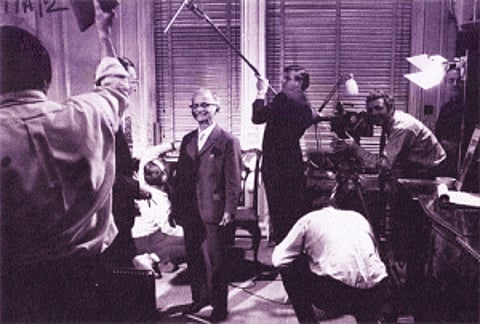

Our continued and callous disregard for Nirad C Chaudhuri, one of the greatest Indian writers of our times, only underlines our contempt for intellectual pursuit, riveted as we are by the antics of small, hollow men and women
Of late I have begun collecting my articles, written over the decades, of which I never bothered to keep a copy. I had kept newspaper clips of some of the articles, dating back to the times when people still read and commented in a meaningful manner by writing letters to the editor. Those days are long gone, perhaps for the better as people seem to have far more useful distractions than to ponder over editorial page commentary. The newspaper clips, which had crumbled over time, went out with the garbage one day. They were not missed.
What has kindled my interest in my old articles (I often can’t recall or remember writing them) is Twitter where some of them have found casual mention in tweets. I wrote that, I ask myself in half amusement. And so it is that I have begun net-surfing to find out what else I have written and forgotten, more out of idle curiosity than any grand purpose of archiving them in one place. It was during one of these net-surfing sessions that I found one of my articles listed as reading material at statweb.stanford.edu. My vanity tickled, I clicked on the listing and discovered it was an article on Nirad C Chaudhuri.
A lot of the stuff in the piece is irrelevant today, but some of it retains relevance. One of my lasting complaints against the BJP is that it has chosen to ignore two stalwarts who have unabashedly promoted Hindu political aspirations regardless of peer group criticism. The first, Nirad C Chaudhuri, is dead and gone. The other, VS Naipaul, is all but forgotten.
The Vajpayee Government could have honoured both, but it did not. I had expected the Modi Government to make amends by way of setting up chairs in their honour. But that too has not happened. like Congress Governments, the NDA too remains trapped in idolising over-idolised idols. It was Nehru and Gandhi earlier; it’s Nehru and
Gandhi plus Patel now. Yes there’s Ambedkar too, the new totem pole of Dalit politics.
Yet I remain hopeful that at least Nirad C Chaudhuri will find some notice while this Government remains in office. It’s in that hope I am reproducing here what I wrote in November 1997 on the occasion of his centenary year.
That was a Sunday too when an “Indian unknown to most of his countrymen” entered the one hundred and first year of his life far away from Indian shores at his semi-detached house on lathbury Road in Oxford.
If he was unknown in 1951 when his first book, Autobiography of an Unknown Indian, was published to critical acclaim abroad and savage criticism at home, there is little reason to believe that Nirad C Chaudhuri is well-known today in India, at least. After all, Three Horsemen of the New Apocalypse, which he wrote in the 99th year of his life and is a feast for those who delight in reading Chaudhuri’s scathing, incisive commentary on our times, found rare mention in the native media.
That, in a sense, is the tragedy of this scholar who travelled all the way from obscure Kishorganj (now in Bangladesh) to his present abode in Oxford a journey punctuated by books that shall survive well beyond the next 100 years. Three classes of Indians have bothered to take note of this remarkable journey that spanned two centuries, beginning in the year of the Diamond Jubilee of Queen Victoria. The first comprises people like me who can read both Bengali and English, but prefer to speak and write in the latter language even while asserting their Bengali identity. People like me who are fascinated by Niradbabu’s intellect.
The second comprises the ‘subaltern’ variety who delight in rubbishing that which they are unable to comprehend. Their knowledge of Niradbabu’s work is limited to the oft-quoted but least understood dedication of his first book: “To the memory of the British Empire in India...” In the not so-distant past, they were content to quote the first sentence of the Communist Manifesto, not having read beyond that.
The third comprises those other Indians like Vidya Naipaul according to whom “Chaudhuri’s Autobiography (of an Unknown Indian) may be the one great book to have come out of the Indo-English encounter,” whose understanding of this land and its people is far superior than that of their critics at home and, in some ways, share Niradbabu’s tragedy.
Everybody who is anybody in the Indian establishment raced to greet Arundhati Roy after she won the Booker. The media went into a tizzy trying to outdo each other in dishing out hype that was nothing more than tripe. One would be curious to know how many in the establishment bothered to send a congratulatory letter to Niradbabu after he was named winner of the Vidyasagar Award and completed almost a century of scholastic pursuit undeterred by the appalling poverty that haunted him for many years and the absence of a steady income after being denied an honourable pension when he retired from All India Radio.
‘Anglophile’, ‘proud’ and ‘anti-Indian’ are some of the epithets that have been hurled at Niradbabu from time to time. That is primarily because he never reneged on his thesis that the Bengali bhadralok he was one of the few that remain of the original breed could not have been what he is but for exposure to all that was good about the Empire, especially European Enlightenment. To deny this fact would be to deny the truth. He preserved an identity that combined the best of both traditions and in distinctly different as well as superior from what we today know as the ‘cosmopolitan identity’ that combines the worst of the East and the West.
‘Anglophile’ yes, but not an uncritical admirer of the West. On the contrary, Niradbabu never spared the West, or for the matter the Empire, for all that was wrong and has since been going wrong with Western perceptions and practices. In a sense, he presented a curious picture of contradictions that sought to outweigh each other but which he was able to combine in perfect harmony. When Niradbabu’s name came up during a discussion among his critics, the image was that of a man dressed in an impeccable Savile Row suit, bowler hat and bow tie. What was ignored was the other image of Niradbabu in dhoti and kurta, pottering about his Oxford home and telling you a thing or two about Hindu cultural traditions.
Such assertions would make the ‘subaltern’ variety pounce upon Niradbabu and accuse him of being a ‘Hindu communalist’. After all, he did refuse to criticise the destruction of the Babri structure “I say the Muslims do not have the slightest right to complain about the desecration of one mosque. From 1000 AD every Hindu temple from Kathiawar to Bihar, from the Himalayas to Vindhyas has been sacked and refined...” and largely refrained from using the word Indian, instead substituting it with ‘Hindu’.
For a full explanation, one needs only to go through the opening essay in The Continent of Circe. “The concept of such an exclusive society (the dominant human group beyond the Indus) was naturally associated with the word ‘Hindu’, and therefore it did not long remain the simple geographical definition which at first it was... Indeed, whenever I use it (the word ‘Hindu’) I feel its cultural connotation very strongly, and I wish to evoke a cultural type...” Although forced into exile by Indians who delight in being unkind to those who prefer to remain unknown rather than conform to conventional wisdom, Niradbabu waged a constant battle to keep this ‘cultural type’ from being stamped out by those who slavishly pander to all that is depraved about the West even while claiming to represent the East.
As for that other charge of unremitting pride that is often labeled by fellow Bengalis, Niradbabu himself answered it through an essay in Anandabazar Patrika in 1994. Explaining that any comparisons that he makes are not with his standards of achievement but between Bengal’s past intellectual glory and present intellectual poverty, he savages his critics in his inimitable manner, reminding them that they never accorded his works their due place in the pantheon of Indian writing either in Bengali or in English. As I said in the beginning, Niradbabu’s tragedy was and remains that recognition came his way not from home but abroad. That’s a pity.
As is the fact that most of the people among whom he is not an ‘unknown Indian’ remember him merely as the author of Autobiography of an Unknown Indian while his other books have fetched little or no notice at bell. For instance, The Continent of Circe is easily the best analysis of Indian society, culture and politics that has been penned of post-1947 India, placing the present in the larger context of India’s past. Similarly, most Bengalis are ignorant of the bulk of his Bengali works which, starting from Bangali Jeebone Ramoni, have systematically analysed the decline and fall of Bengali culture and traditions.
If a reason must be attributed to this callous disregard for one of the greatest Indian writer of our times, it is our inability to honour our achievers while they are alive. Moreover, our callousness proves our contempt for intellectual pursuit, riveted as we are by the antics of small, hollow men and women in high places who have come to substitute the men who ruled India when it was a part of the British Empire.
(The writer is a current affairs analyst based in NCR)