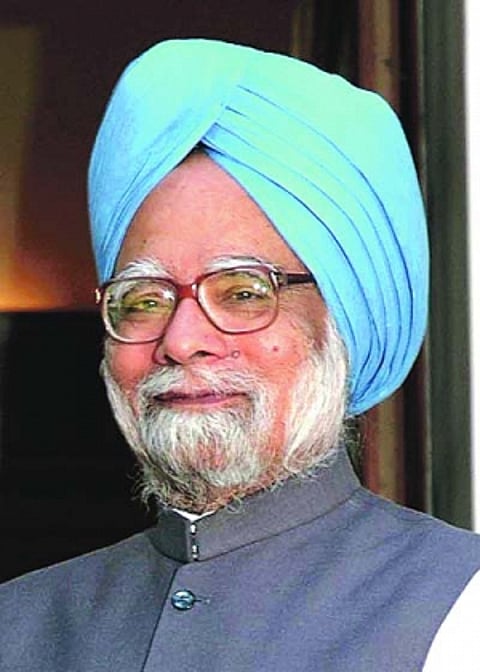

Negotiating choppy waters in a turbulent economic scenario, Prime Minister Manmohan Singh on Friday chose to put a brave face and assured that though the economy is going through a difficult period, his Government will leave no stone unturned to bring things back to normal and at the same time warned the Opposition not to judge the UPA Government’s performance by just one bad year.
He said that in addition to the recently announced relaxation in foreign direct investment (FDI) norms in sectors like defence production and telecom, more reforms in FDI are on the anvil which would push investment in the infrastructure sector and this would percolate into boosting overall economic growth. Citing reasons like a steadily weakening rupee and widening current account deficit (CAD) behind the grim economic situation, he expressed optimism that steps being taken by the Reserve Bank of India (RBI) to arrest the negative trends would help ease pressure in near future.
The Prime Minister, who was speaking at the annual meeting of the industry body Assocham, added that the Government was committed towards bringing the CAD under control by addressing both the demand side and the supply side of the problem, especially to contain demand for gold and petroleum products. He sounded contradictory while claiming on one hand that the fundamentals of the economy were strong, yet in the same breath saying that the growth rate in the current financial year was likely to be lower than 6.5 per cent estimated at the time of presentation of the Budget in February.
“We will leave no stone unturned to ensure that the economy rebounds. I appeal to each one of you not to be overcome by negative sentiment… let me begin by stating upfront that we, like most other countries, are going through a difficult period... It (industry) is looking to the Government to bring the economy back to a higher growth path. This is a legitimate expectation and is also upper most in our mind,” he said. He added that when things don’t go as per expectations, it is the responsibility of the Government to be pro-active.
Noting that the most immediate cause of worry is the recent volatility in foreign exchange markets, Singh said, much of this was due to global markets reacting to the likelihood of a withdrawal of quantitative easing by the US Federal Reserve. “large volumes of funds were withdrawn from emerging markets and there was depreciation in many emerging market countries... We too experienced a sharp depreciation in the rupee. In our case, it was perhaps exacerbated by the fact that our Current Account Deficit (CAD) had expanded to 4.7 per cent of GDP in 2012-13,” he said.
Singh however did not let go of the opportunity to take a dig at the UPA Government’s political opponents, saying “we have had one bad year. I assure you we will get out of it.” He added that they (Opposition) focus on the experience of one bad year. “This makes for good television but it is a very distorted picture.” To prove his point the Prime Minister went into comparison mode, adding that the average growth rate in the 8 years of the UPA from 2004-05 to 2012-13 was 8.2 per cent as against 5.7 per cent in the previous eight years (of which the NDA Government was in power for six years).
Talking about poverty reduction, the Prime Minister said that the percentage of population below the poverty line declined at 0.75 per cent per year before 2004-05. It has fallen more than 2 percent per year between 2004-05 and 2011-12, he added. Coming back to factors which have had a negative effect on the economy in recent times namely gold imports and high petroleum prices, Singh said, “gold imports declined sharply in June, and I hope they will stay at normal levels from now on.”
On petroleum prices which have risen by Rs 7 a litre over the last 45 days, he said that rupee depreciation has to some extent neutralise the calibrated steps to reduce under- recoveries of the oil marketing companies. At the same time he added that “our policy of adjusting prices to progressively eliminate under recovery remains”. On the supply side, he hoped, depreciation of rupee would give push to export efforts and added, the government has been trying to remove the constraints in export of iron and other ores which saw a considerable decline over the last one year.
“looking ahead, the rupee depreciation will help Indian industry to compete effectively with other countries, both in export markets and against their imports in our markets,” Singh hoped. Talking about the Reserve Bank’s recent initiatives to arrest rupee decline, Singh said, these steps were not meant to signal increase in long term interest rates.“They are designed to contain speculative pressure on the currency. Once these short term pressures have been contained, as I expect they will be, the RBI can even consider reversing these pressures,” he said.
Singh further added that the Government is on way to conclude a free trade pact with the European Union and hoped that industry would take advantage of the agreement to increase its competitiveness. On CAD, he felt that “ideally we should bring the CAD down to 2.5 per cent of GDP. It is not possible to do this in one year, but I expect that the current account deficit in 2013-14 will be much lower than the 4.7 per cent level recorded last year. It will decline further next year”. The Prime Minister further said that the Government would stick to the fiscal consolidation road map and restrict the deficit to the target of 4.8 per cent of the GDP in the current financial year.