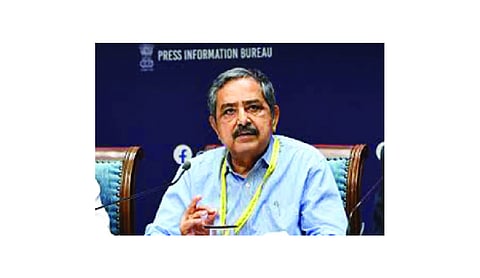

India is perhaps still not secure regarding its food supply across the various products, as the country is the world's largest importer of edible oils, NITI Aayog Vice-Chairman Ashok Kumar Lahiri said on Friday.
Addressing an event here, Lahiri said India meets more than half of its edible oil needs through imports, estimated at 17 million metric tonnes, valued at about USD 20 billion.
Similarly, India is both the world's largest producer and consumer of pulses, and accounts for roughly a fourth of total global pulse consumption, approximately 25 to 27 million tonnes annually.
"We are talking about Viksit Krishi in Viksit Bharat in 2047. As we move towards Viksit Bharat at 2047, are we secure regarding our food supply across the various products? Perhaps not as yet," he said.
Lahiri said he was surprised to learn that chana (gram), which Indians eat, comes from Australia; lentils (masoor dal) come from Australia and Canada; and some pulses come from Myanmar, Africa, and Russia.
"Now you can ask what is wrong with India importing edible oils or oil seeds from Indonesia, Malaysia, Argentina, Brazil, Russia, and Ukraine, and pulses from Australia, Canada, Myanmar, Africa, and Russia.
"The problem is, first, the issue of vulnerability to global supply disruptions or price shocks," he said.
Lahiri said anyone familiar with India knows 'dal-chawal' or 'dal-roti' is the staple of the vast majority of the people.
"For our dal-chawal or dal-roti, we require pulses and edible oils. Any disruption of supply of these essential commodities or price shock can assume the gravity of a strategic disaster," he said.
Furthermore, Lahiri suggested that, given the need for crop diversification in the country and a shift away from the dominance of wheat and paddy in Indian agriculture, the low water intensity of edible oils and pulses makes it sensible to promote them in Indian agriculture.
The NITI Aayog VC emphasised the need to reduce and eliminate waste in Indian agriculture.