
Eyes 2G spectrum proceeds to boost revenues
Having just managed to garner Rs 3,000 crore out of the total Rs 40,000 crore disinvestment target for the current fiscal so far, the Government has accepted that it is in a tight spot.
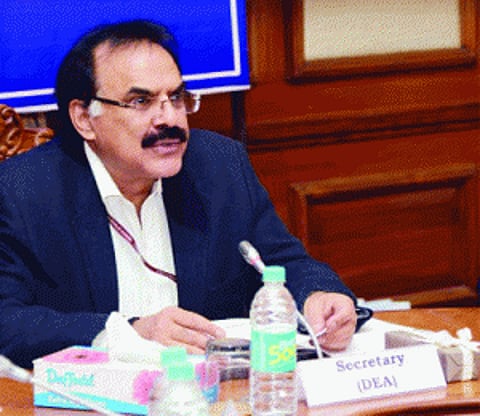
Economic Affairs Secretary in the Finance Ministry Arvind Mayaram in an exclusive interview with The Pioneer expressed optimism that the Government will manage to come out of the situation and his confidence stemmed from the enthusiastic opening to the 2G wireless spectrum auction, where till Tuesday the Telecom Ministry had received bids worth Rs 44,600 crore.
“We are not in comfort zone, we are tight, but we will manage,” Mayaram said when asked whether the Government was in a comfortable position as far as managing funds was concerned.
He added that the Government will review what more needs to be done to generate funds and expressed hopes from the 2G wireless spectrum auction, which began on February 3.
“We will review what (more) is to be done, it is not a one time exercise (to garner funds). There are a lot of things which are happening like the 2G spectrum auction. We have good numbers (referring to bids received by Tuesday). It is only the first round, but we are hoping that it will improve,” Mayaram said.
The Rajasthan cadre bureaucrat, who is seen as the main points man in Team Chidambaram, in fact rubbished the oft-repeated allegation of policy paralysis syndrome from which the UPA Government is alleged to be suffering from.
“When you say policy paralysis, I think you are dated, your information is dated when you say this. Nobody even talks about it. It is not an issue anymore. Everything is happening now. The Cabinet Committee on Investment (CCI) is meeting almost everyday and the latest number which we have with us is that $100 billion worth of clearances have been given by CCI,” he informed.
On the contentious issue of oil subsidy payouts to the Petroleum Ministry, which every year causes lot of heartburn between the Petroleum Ministry and the oil marketing companies (OMCs), Mayaram admitted that though subsidies are a problem which has emanated from the fiscal deficit, at the same time he hinted that such realities exist owing to the political compulsions.
“This (subsidies) is a problem, and it is a problem on the fiscal deficit side. It is a choice which the Country has to make whether we want to use the money to build infrastructure or to give subsidy. In our opinion, subsidies are counter productive, they are market distortionary, and to the extent one can eliminate them these should be eliminated. But then it is a political economy and the decisions are often taken on account of realities which are not purely economic realities, so we can’t have any quarrel with them,” the Economic Affairs Secretary said while putting things in perspective.
Asked if the Petroleum Ministry’s decision to provide 100 per cent gas supply to the CNG and PNG sectors would have any financial implications on the Government’s finances, Mayaram said that though the move was not discussed with his department, the burden may not be that high in the current fiscal.
The Petroleum Ministry on February 3 had announced that from the existing 80 per cent provision of gas to CNG (transport sector) and PNG (piped cooking gas sector), it had hiked it to 100 per cent, adding that domestic gas fields would produce more which in turn would reduce dependence on imported gas. It had claimed that there would not be any subsidy burden on it.
Though Mayaram refused to comment on expectations from the forthcoming Interim Budget, saying that it is something on which only Finance Minister P Chidambaram can throw light on, he underlined the need to give more sops to the manufacturing sector in order to attract greater investments which in turn would push India’s trade vis-à-vis China.
Commenting on the recent uptrend in India’s trade deficit compared to China, he said,
“China is a different system, so I will not say anything about comparing with China as a democratic system has an inbuilt slowness about it and there is much greater deliberation that goes in regarding policy making.”
Highlighting the significance of focussing on the manufacturing sector, he added that “we will have to work very hard in creating core competence in certain areas which are globally competitive and then only we can export more. So we have to now look more on manufacturing for a long time. We will have to now focus on it. The (Industrial) Corridors which are being created (between Delhi and Mumbai), these will go a long way in creating the right kind of atmosphere for higher investments”.