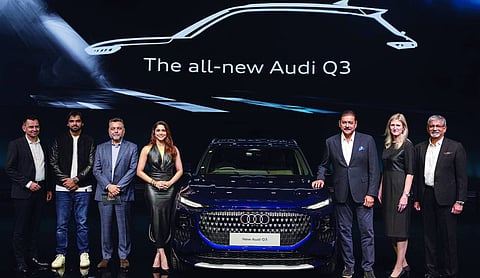

The third-generation compact SUV is the first of three key launches as the German luxury carmaker aims to double its market share Audi India has called 2026 a “transitional year.” With the launch of the third-generation Q3 on October 16, it is signalling that the transition is over.
The new Q3 is assembled locally at the Škoda Auto Volkswagen India plant in Chhatrapati Sambhajinagar, Maharashtra. It starts at an introductory ?51.99 lakh for the Nova variant and goes up to ?55.99 lakh for the Zenith (ex-showroom).
Both get a 204hp 2.0-litre TFSI petrol engine and quattro all-wheel drive. Audi had said it would price the car in line with rivals rather than chase volumes with a low entry tag.
The stakes are high. The Q3 has sold about 26,000 units in India to date, and Audi expects it to bring in 25-30% of its volumes in a normal year. Brand director Balbir Singh Dhillon admits that ageing products and supply constraints left gaps in the portfolio. That kept sales flat this year even as the luxury market heads for a record 58,000 units, up nearly 12%.
The Q3 opens a product offensive. The A5 sedan, also to be assembled locally, follows in the first half of 2027, and the flagship Q9 SUV arrives as an import in the second half. Dhillon has promised “a lot of action from Audi in the next 20 months,” with double-digit growth targeted from 2027.
Products are one of three pillars, alongside network expansion and customer experience. Audi plans to grow from 28 showrooms to around 40 by the end of 2027 and more than 50 by 2030, with tier-II and tier-III cities central to the plan. Roughly one in three sales goes to existing Audi owners, so keeping customers matters as much as winning new ones.
The goal is to double Audi’s share of the luxury market from about 8% to 15-16% within three to five years. Local manufacture of an electric vehicle is, in Dhillon’s words, a question of “when, not if.” The proposed India-EU free trade agreement could also open the door to more models.
Challenges remain, mainly a weaker rupee against the euro that is pushing up costs and prices. But for the first time in a while, Audi has a fresh product to sell and a plan behind it. Whether the Q3 can carry the weight of that plan is the real test.