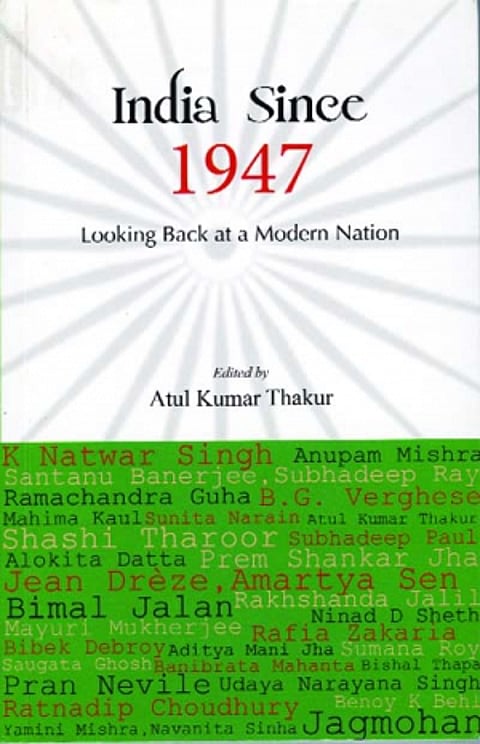

In one of the articles, Ramachandra Guha talks about the decline of the bilingual intellectual in India. Excerpts
India Since 1947
Author: Atul Kumar Thakur (ed)
Publisher: Niyogi Books, Rs 395
The decline of the bilingual intellectual in contemporary India is a product of a combination of many factors: Public policy — which emphasised the mother tongue alone; elite preference — which denied or diminished the mother tongue altogether; social change — as in new patterns of marriage; and economic change — as in the material gains to be had from a command of English.
Those who know the history of pre-colonial India may have interesting and important things to say about the multilingual nature of intellectual discourse in past times. Meanwhile, as someone who has a casual acquaintance with contemporary Europe, let me suggest that the intellectuals in that continent have gone in exactly the reverse direction to ours. Once, they operated mainly or even exclusively in the language that defined their nation — the French in French, the Spanish in Spanish, etc. Now, with the emergence of the European Union and the growth of English as a global language, these French and Spanish and German thinkers have abandoned their opposition to the foreign tongue without disavowing their own.
I present two stories which illustrate the sometimes unanticipated glories of the best kind of linguidextrousness. When HY Sharada Prasad died in 2009, a letter-writer in a magazine complained that in all his years in New Delhi, serving Prime Ministers, Sharada Prasad had never lifted a finger for a single Kannadiga. For what the letter-writer did not recognise is that by translating the novels of Shivarama Karanth into English, Sharada Prasad had done a far greater service to the Kannada language, and to Kannadigas, than had he got some of them 10 minutes with Indira Gandhi or an out-of-turn gas connection.
The other Indian of my acquaintance who comes closest to this multi-lingual dexterousness is the writer and public servant Gopalkrishna Gandhi. literary critics know Gopal Gandhi as the translator into Hindi of Vikram Seth’s novel A Suitable Boy. He has also written his own books, in English. However, these are only two of the languages this good man can fluently read, write and speak. 1 recently discovered that his first literary production was undertaken as a boy of 17, when he translated the memoirs of Manu Gandhi from Gujarati into English. He speaks Tamil, which was the language of his mother, quite beautifully. More recently, he has acquired an adequate knowledge of Bengali.
For all his achievements, among Indian intellectuals at any rate Gopal Gandhi can only be known as the younger brother of the philosopher, Ramchandra (Ramu) Gandhi. Although he wrote several important books, Ramu Gandhi was at his best at the lectern. I have never heard a more brilliant lecturer-a judgement that would I think be endorsed by most people who beard him speak in either Hindi or English, among them the very many students he trained and inspired at the universities of Rajasthan, Delhi, Hyderabad and Santiniketan. After he quit academic life, Ramu Gandhi’s main theatre of operation was the India International Centre (IIC), where he would lecture occasionally in the auditorium.
Ramu Gandhi was the son of Mahatma Gandhi’s youngest son, whereas his mother was the daughter of C Rajagopalachari. In the mid-1950s, when Ramu was entering university, Rajaji took an extended holiday from politics to write modern renditions of the Ramayana and the Mahabharata. He wrote first in his native Tamil, and then translated them into English.
These modern versions of the epics proved so popular that a demand arose for translations into other languages. Rajaji’s daughter, lakshmi Devadas Gandhi, volunteered to do them in Hindi, a language she knew well in part due to long residence in New Delhi. The Hindi versions sold briskly and continuously — they were still selling in the 1960s, and well into the 1970s. Sometimes towards the end of that decade Mrs Devadas Gandhi decided to make a will. However, as the daughter and daughter-in-law of ascetic and incorruptible politicians, she had no worldly possessions to speak of. Of course except for the royalties from those translations. Mrs Gandhi had three sons. The first, Rajmohan was a journalist and author of popular works of biography and history — surely the Fourth Estate and his publishers would take care of him where he ever in distressIJ The youngest son, Gopal, was member of the Indian Administrative Service — he would, in time, get a sarkari pension linked to the cost-of-living index. That left the middle son, the dreamy philosopher who had left six jobs and declined to accept six others.
So it was to Ramu Gandhi that the royalties were willed, and to him, after his mother’s death in 1983, which they came. Every year, without fail, Ramu would get a cheque for several thousand rupees that would comfortably cover the cumulative bills, for that year from the IIC bar. And, so, in this manner, works originally composed in Sanskrit, then rendered in Tamil and still later translated into Hindi, were to fuel the belly and the mind of the most brilliant man to have walked the lawns or entered the bar or spoken in the auditorium of the IIC.
The story may be apocryphal, but it deserves to be true. For it illustrates like nothing else the beauty and potency of intellectual and literary bilingualism.