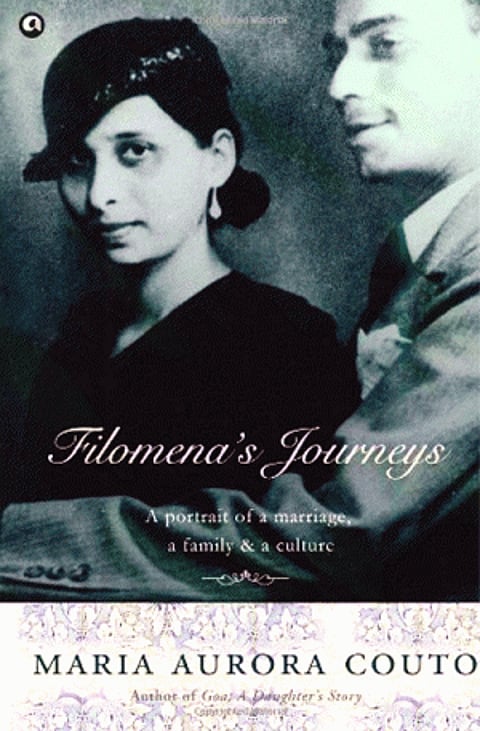

Filomena’s journeys
Author: Maria Couto
Publisher: Aleph,Rs 495
This book is a delightful read as it chronicles the annals of a rooted, elite Goan family in subtly-etched pictures of yesteryears; it serves as the voice of the time of the author’s class, writes Savia Viegas
Maria Aurora Couto’s book is a great read. If you revel in subtly-etched pictures of yesteryears and enjoy good writing, then you should simply prop up a pillow and devour the book. But if you are the one to apply an academic’s lens, then you might dot a problematic in the way the voices and conversations are deployed in the creation of a positivist grand narrative — hegemonic and representative of a community in which the family’s private saga unfolds. But then Couto is very clear that both her books —Goa: A Daughter’s Story and Filomena’s Journeys — are the voice of the time of her class. Nonetheless, it takes immense courage to plumb the depths in this manner and yank out detail upon detail of true-to-life family portraits with brutal honesty.
The book is interestingly-scripted in the manner of taking field notes. Couto interchanges her voice as daughter, narrator, researcher and at times, even as an incognito persona, culling details and interspersing them. Her academic background enables her to prop the narrative with period detail, allowing the flow of biography to be embellished, giving the younger readers a grasp of the time.
The author’s parents, Francisco (Chico) de Figueiredo and Filomena Borges, are the central characters, caught in the pivot of early 20th century Goa. Times, they were a-changing then, as many of Goa’s elites were beginning to rethink colonialism and their own role as a ‘Comprador Class’. Chico’s mother (also Aurora), unable to cope with losing the privileges of her class on her father’s death, takes to drinking and ‘Soon Aurora’s alcoholism was a well known secret…’ Chico’s aunt, Claudina, on the other hand, was married into the enlightened Correia-Afonso family and joined the voices of political dissent seeking liberation of Goa.
Be a bhatkar, multiply the wealth; be a doctor, draw in symbolic value for the family; be a lawyer, help the family ‘grow’ its wealth by astute property purchases; or be a priest, to work in ways so that the family as a social ‘hierarchical’ unit prospers. This was the unwritten dictum among elite Goan families — to push their sons into these designated professions, ensuring continuity and prosperity. But given his temperamental and artistic vein, Chico did not fit into this familial paradigm.
Having set his heart firmly on music (despite a medical degree) Chico courted trouble, aggravated by his personality and further exacerbated by the loss of privileges that the landed gentry had hitherto enjoyed. With this volatile combination, he hurtled himself on a path of self-destruction. In colonial Goa, the elites learnt music but very few opted for a career, as the church choirs and its violin maestros were drawn from the working class.
On the other hand, Filomena, the archetypal feminine-suffering, patient and full of positive energy, and raised in her sheltered grandparent’s home on adages like ‘life had to be endured, so learn to obey…’ is the real hero of the biography.
Many women from this class, when pitted against odds, managed property and raised families in a manner unthinkable, given their sheltered upbringing. The union of Filomena and Chico seems destined in the way it unfolds. Filomena’s compassion, love and loyalty cannot arrest his fall into alcohol dependence. The situation of the growing family, Chico’s irrational actions and the bleak financial situation become calamitous, forcing Filomena to relocate to neighbouring Dharwar where she raised a family of seven children.
The biography is replete with strong, realistic and graspable women whose innate strength can be evidenced only in a narrative like this. Since 2000, fiction written by some Goan women has portrayed strong women characters at its core — Margaret Mascarenhas’ Skin (2000), Belinda Viegas’ The cry of the Kingfisher (2010)and this reviewer’s let me tell you about Quinta (2011), to mention some. Couto’s biography of Filomena and Chico in several ways authenticates the root of these earlier works of fiction.