
- HOME
- INDIA
- WORLD
- BUSINESS
- STATES
- LAW & JUSTICE
- ENTERTAINMENT
- SPORTS
- VIEWPOINT
- LIFESTYLE
- TECH
Author: Shivaprasad
Naturopathy is changing as the world’s healthcare system shifts towards prevention and holistic care
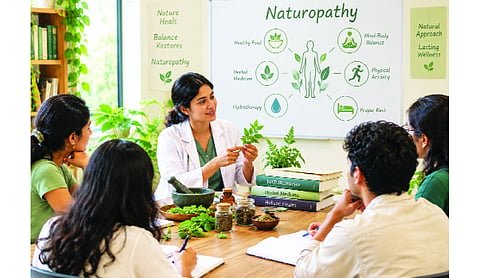
Naturopathy is changing as the world’s healthcare system shifts towards prevention and holistic care. What was once seen as an approach is now becoming part of mainstream health systems. The future of education rests on three main ideas: working with other fields, gaining real-world clinical experience and conducting strong scientific research to meet higher patient expectations.
Making science part of naturopathic learning
In the past, naturopathic medicine relied heavily on healing traditions and what had worked in practice. These roots are still important. Today, the focus is shifting towards evidence-based care. Colleges and naturopathic medical schools are now including science in their programmes. Students are learning about trial design, biostatistics and how to conduct organised research.
This change helps future practitioners link wellness beliefs with modern scientific proof. Students are encouraged to conduct their own small studies, write research papers and look closely at treatments and lifestyle changes. This emphasis on research builds trust in the profession.
Direct hands-on clinical practice
Book knowledge is not enough. To truly help patients, naturopathic students must learn through hands-on work. Today’s training includes clinical experiences early in the programme. These experiences go beyond classrooms and online lessons.
They include:
· Hospital outpatient rotations: Students follow patients with chronic diseases such as diabetes, high blood pressure or heart disease. As new kinds of patients come into the clinic, students learn how to treat them.
· Integrative health clinics: Under supervision, students can use yoga therapy, hydrotherapy, herbology, nutrition and many other approaches to treat patients.
· Community health outreach: Students are offered the chance to undertake an internship in an area of community health of their choice to address public health issues and help people who do not have access to healthcare.
Working together across medical fields
Integrative healthcare is a team effort these days, and future education is evolving towards models that move away from isolating medical schools, nursing schools and other health education programmes into separate silos.
Students take part in events such as grand rounds, where doctors from different fields share patient cases. They work together on research projects and attend shared classes on pharmacology and diagnostics. This collaboration helps naturopaths speak the same language as conventional doctors.
The ways in which naturopathic medicine can enhance patient care, as well as the ways in which conventional medicine can gain knowledge of alternative approaches to treatment without the use of drugs, are endless.
What it all means
The path for naturopathic education is clearly laid out through a combination of academic research, hands-on clinical training and cooperation with other healthcare professionals. This results in a well-rounded, truly knowledgeable doctor who is familiar with healing as well as conventional medicine.
Naturopathy has taken a step in the right direction towards strengthening its role within healthcare and has the potential to provide safer, better and more complete patient care worldwide.
The writer is the Principal, SDM College of Naturopathy and Yogic Sciences, Ujire; Views presented are personal.