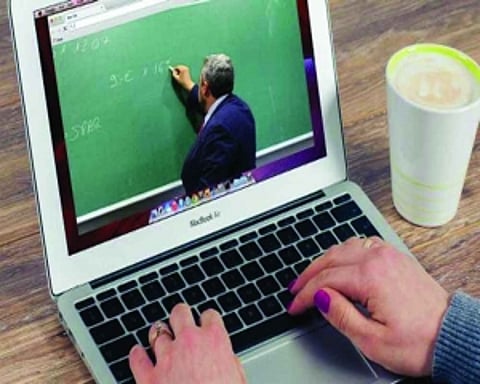

Online learning has several flavours but the major two are live and recorded classes. Partha Halder tells you why the latter proves to be more beneficial for students
Ever since the lockdown was announced on account of COVID-19 pandemic, it took a toll on students as educational institutions had to shut down. But the disappointment was short lived as institutions migrated to online teaching. Students were back to learning mode but in a virtual classroom. Online teaching has several flavours but the two major ones are Live classes & Recorded classes. Which of the two is more effective for learning? Not just that there are several other questions like ‘does it depend a learner’s profile’; ‘does it depend on the subjects that are being taught’. So firstly, let us try and figure out the fundamental difference between the two modes of teaching.
Live online classes: It is an Instructor Led Learning Model wherein a teacher has the control of a class; they drive the learning objective and they even set the pace of learning. This learning model allows two-way communication wherein the learning is synchronous, in other words a student can watch/listen to a teacher, interact with them and even ask questions.
The learning environment consists of teacher & peer group. Since it’s a live class, teacher can see the students and can assess them at every moment while they are teaching. Depending upon a student’s goal, progress and level, teachers can adjust/modify their lecture and the difficulty level of sample questions or numerical problems. While teaching,
Pre-recorded classes: It is a Self Paced Learning Model wherein the learner has the control viz ‘when to study’; ‘how much to study’; ‘pace of study’. This learning model allows one-way communication wherein learning is asynchronous. A student can only watch/listen to a teacher in a recorded video session, so it is passive. There is no difference in lecture content or level of teaching as per learner’s ability or appetite. All types of students are served the same content i.e common for all. Hence learning as per student’s ability gets suppressed. There is no provision for students to ask questions in real time. So the essence of real learning is lost.
It is ideal for adult learners who are matured & self driven. But in the K-12 segment, students are of lower age group, especially those preparing for competitive exams, they need a lot of intervention by teacher. So, a two-way synchronous communication is the way forward.
The writer is Center Head and HOD — Chemistry Department at FIITJEE Punjabi Bagh