
Author: Padmakumar Nair
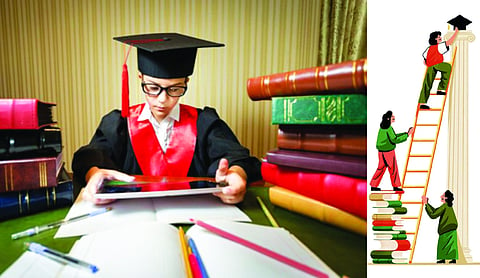
Before choosing a programme, ask what kind of thinker it produces, not what salary it might predict. The career ladder is changing shape. The students who thrive will be the ones who learned to climb walls that do not yet have rungs
As careers evolve and technology reshapes industries, students must look beyond current job trends when choosing a degree. Specialised knowledge, continuous learning and the right academic environment can help them adapt to emerging opportunities and build meaningful, future-ready careers
Every year, I watch thousands of bright young people make one of the most consequential decisions of their lives: choosing a degree using a map drawn for a world that existed twenty years ago.
The ladder they have been told to climb was designed for a different economy: stable industries, predictable progressions and a clear line from qualification to career. That structure served generations well. Today, it deserves a harder look.
The job you’re training for may not exist yet
The World Economic Forum estimates that 65 per cent of children entering primary school today will eventually work in roles that do not currently exist. That figure gets cited often enough that it risks becoming background noise. Sit with it for a moment, though.
When I began my academic career, the idea of a “prompt engineer”, a “climate risk analyst” or a “human-AI collaboration designer” would have seemed like science fiction. These roles exist today and are growing fast. The institutions genuinely preparing students for them are asking a fundamentally different question: not what employers want right now, but which capabilities hold their value across multiple waves of disruption.
Choosing a degree based purely on current hiring trends is like navigating by a star that has already moved.
Depth still matters, but the container has changed
A persistent myth circulates among students and parents that, in a world of rapid change, specialisation has become a liability. The argument runs that breadth wins, that generalists thrive and that deep expertise has been made redundant by automation.
The evidence points elsewhere.
What has shifted is the container, not the value of depth itself. A student who builds genuine mastery in materials science, computational biology or urban infrastructure still carries a significant advantage. The difference is that mastery today must travel across disciplines. An engineer who understands policy. A biologist who can read financial models. A designer who thinks in systems. These are the professionals who will lead because they can translate between worlds that rarely speak to each other.
At Thapar, this is precisely the shift we are building into our curriculum, surrounding technical rigour with the contextual fluency to apply it in conditions that come without instruction manuals.
The degree is a starting point
One of the most damaging expectations a student can carry into higher education is the belief that a degree is a transaction. Pay fees, attend classes, collect a certificate and receive a career.
The students who thrive over a twenty-year arc treat their degree as a foundation for continuous learning rather than a completed achievement. The shelf life of technical knowledge has shortened dramatically. Skills that were considered advanced in 2018 have become baseline assumptions today. Skills that will define 2030 are still being named.
Research from McKinsey Global Institute suggests that, by 2030, up to 375 million workers globally may need to shift occupational categories entirely due to automation. The practical response to that reality is to develop the habit of learning, adapting and rebuilding knowledge. A degree programme worth choosing is one that actively cultivates that habit, not one that simply transfers information.
One question worth asking before enrolling anywhere is this: Does this institution teach you to work through problems for which it has no prepared answers, or does it hand you a template and call it education?
Who you learn alongside shapes who you become
This rarely appears in university brochures, which is precisely why it deserves attention.
The people around a student - peers, faculty and industry practitioners they encounter along the way - exert a quiet but lasting influence on how they think, what they attempt and how far their ambitions stretch. Spending years alongside people who are building things, questioning assumptions and operating at the edges of their fields does something to a person’s internal sense of what is possible. It recalibrates the ceiling.
This is why the learning environment carries as much weight as the curriculum itself. Institutions with active research cultures, working industry partnerships and genuine communities of practice give students something a syllabus alone cannot: a live education in how people with real expertise work, collaborate and navigate uncertainty together.
Ask a different question
Students who build meaningful careers over the next three decades will be those who approach this decision with some intellectual honesty. The degree matters. The institution matters. The people around you matter. The thinking habits formed along the way matter most.
Before choosing a programme, ask what kind of thinker it produces, not what salary it might predict.
The career ladder is changing shape. The students who thrive will be the ones who learned to climb walls that do not yet have rungs.
The writer is Vice Chancellor, Thapar Institute of Engineering and Technology (TIET); Views presented are personal.