
Prof Sourindra Bhattacharjee analyses the discussion organised by Delhi School of Business on what the Budget 2021 has on offer and how it will help the economy
The year 2020 was a tough deal. With countries facing negative growth leading to loss of lives and livelihoods owing to the pandemic, there were a lot of expectations from the Budget 2021. The presentation of the Budget therefore was a challenging and probably a unique exercise.
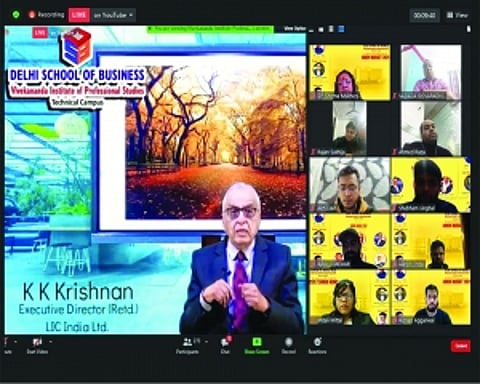
Delhi School of Business organised an on-line discussion on the Union Budget 2021 inviting academicians, scholars and industry experts from within and outside the country to understand and unfold the nuances of the budget and its implications for overall growth and health of the economy, including welfare of its citizens.
In his welcome address, Dr Rajiv Ranjan Thakur, Director-Delhi School of Business said that the current budget was seen a ray for hope all stakeholders in the economy amidst the gloom of pandemic faced by the nation. He did also mention about the varied sentiments expressed on the budget, ranging from it being a grand and visionary one to a totally disappointing exercise. He expressed the deliberations on the budget will ease out confusion.
The ball was set rolling by Dr SC Vats, Chairman, Vivekananda Institute of Professional Studies (VIPS) hailing the budget presented under extraordinary pandemic situation, expressing his hope and confidence about the country’s renewed capability of tackling the menace, boosted by production of two indigenously developed vaccines and its roll out as well as increase in health expenditure. He also touched upon the undesirable social and economic impact of the prolonged farmers agitation in the country.
The ensuing discussions by the eminent panellists moderated by Prof #SiddharthMishra, an eminent journalist and Chairman, VJMC, VIPS, reflected on the age-old debate of diverse opinion of any economic situation, especially the budget. The Government’s road map for managing the growth and welfare in the country is highlighted in the annual budget is often debated among various stakeholders in various forums, providing their own rationale about its efficacy on the overall direction of the economy, budget balance sheet and its impact on the multifarious sections of the society and economy.
Supply lead versus demand induced growth
Voicing his reservations of the Government not getting its macro-economics right, Prof Arun Kumar, Malcom Adiseshiah Professor, Institute of social Sciences, opined that present capital intensive expenditure strategy is not going to result in nominal growth of 14.4 per cent as promised in the budget. The current official negative growth figures of minus 7.7 per cent do not include that of the unorganised sector, facing negative growth rate of 29 per cent, leading to high job losses. According to him, following capital intensive supply led growth will not generate higher employment and cause delay in boosting the economy. He also elaborated that much required budgetary allocation such as transfer for welfare programmes, including employment generating schemes addressing the woes of the unorganised sector has not been adequately addressed in the budget.
Allaying the concerns of the high fiscal deficit in the budget 2021 which is tolerable under the current economic situation, Prof. Priyaranjan, Professor of Economics, University of California, Irvine USA however, lauded the thrust of the budget on the increase in spending on infrastructure, although lopsided and somewhat politically motivated. Infrastructure spending is likely to have a higher multiplier effect, impacting the growth and has the potential to create jobs in future. He also did express use of production subsidy as a much effective path to integrate domestic producers with the global economy than current policy of discretionary protectionist tariff. He also outlined that the problems faced by the informal sectors has not been fully addressed.
Dhananjay Sinha, Director & Head Institutional Research, Systematix Group, spoke about the consolidation expected with Budget 2021 to drive efficiency, productivity, better capital allocation and credit growth. “We believe the Government is telling us that while it is has taken expedient measures to get the economy back on track, the effort is also to reinforce the sentiment that it is also taking structural reform measures,” he added.
Public versus Private Debate
The policy prescriptions of the Government on the divestment, revenue generation, structural and institutional reforms and welfare measures in the budget opened up a pandora’s box of market or mixed approach the country should be following in the future. The role and business the Government is in now and it should pursue in future in the medium and long term through its public sector entities was debated at length in the Union 2021 discussion.
Prof. Shiv Kumar, Ex-MD SBBJ during his address praised the initiative which will attract private investment in the country, mainly, increasing FDI in insurance from 49 per cent to 74 per cent, revenue generation through divestment of Banks and Air India, new institutions such as Asset reconstruction company, Development Financial Institution for long term financing, faceless assessment and relaxation of disputed tax assessments to instil confidence in the business community. He concluded that it is high priority for the Government to decide on what it needs to focus on and contribute to its overall strategy of minimum government and maximum governance.
Elaborating on his opinion on the need for prudent spending of taxpayers money, Vijay Sardana, Techno-legal expert- advocate, opined that Government should refrain from undertaking populist measures and direct its efforts in improving efficiency to face global competition, using technology to build skills and promote innovation in the country and help in achieving growth in the medium term. The policy shift of privatisation as envisaged in the budget is an appropriate measure. He also hinted at the need for use of new technologies to support basic needs programmes, especially in education, to improve its effectiveness and skilling new generation in the remote areas.
Prof Rattan Sharma, Professor Emeritus, DSB gave a different view of the required role of Government in an economy. Highlighting the supporting role played the Government during financial crisis in 2008 and most recently during the pandemic situation. Government involvement, even in a limited way, should be in public and welfare interest.
Specific Sector View
As touched upon by Dr SC Vats on the protests by the farming community which got the similar attention in the recent past in the media, panellists also gave views of the past and present agricultural policies and investments in the country. According to Vijay Sardana, the current agricultural policies such as the MSP is a self-defeating phenomena which has promoted inefficiency in production and distribution system, taxing the exchequer. The upshot is country is laden with high expenditure in managing FCI, which could be invested in other sectors, capable of generating employment and higher returns. A detailed study of current scenario of agricultural production and marketing therefore is required to understand the ground realities and address the malaise
Echoing the same sentiments, Dhananjay Sinha, Director, Systematix Goup said that reforms are welcome in the agricultural sector to address the discord between the decrease in consumption of cereals vis-Ã -vis its increase in cereal production and consequent its procurement by the Government leading to drain of resources. He also touched at length on the progress made in the financial sectors and reforms that has been highlighted in the budget 2021. With higher retail participation and more transparent bonds and debt market, it is moving towards a more vibrant financial sector. Prof. Rattan Sharma discussed on the institutional reforms such as development financial institutions, asset reconstruction company will help to ease the stress on current banking system and can propel growth in the economy
The allocation in the social sector and the informal economy was touched upon by all the panellists, complimenting increase in health expenditure by 137 per cent for fighting COVID situation and building health infrastructure. Some criticisms of the stagnant or even lower budgetary allocations for the employment generation schemes to support the informal and unorganised sector and in education has been highlighted by Prof Arun Kumar and Prof Rattan Sharma.
Conclusion
As seemed from the discussion of the Union Budget 2021, the Government has given a new direction for the achievement of the vision of Atmanirbhar Bharat. The disagreement on either allocation or policy shifts envisaged in the budget evident during the discussion reflects the healthy debate in a democratic country which we follow and practice. We as a nation will always strive collectively for growth, prosperity and equity, and hope this budget will show us the light at end of the dark tunnel of pandemic period faced by the world.