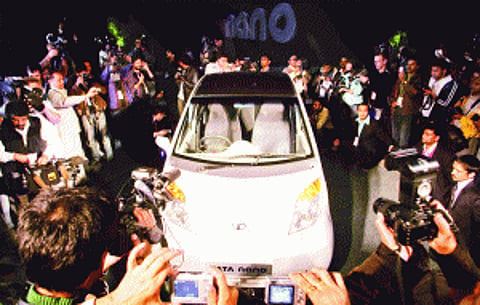

While Ratan Tata’s aim was to bring people off motorcycles and into cars, even at its most basic Rs 1 lakh price-point, the Nano was three times more expensive than a Hero Honda Splendor, the best-selling 100cc motorcycle in India, writes KUSHAN MITRA
A month after the launch of the Nano at Pragati Maidan, we at Business Today after a protracted negotiation of sorts with Nira Radia had worked out a potential cover story on ‘The making of the Nano’. Although, we were scooped by Jehangir Pocha of Businessworld magazine — and according to one of my editors at the time, the reasons were beyond mere readership — we persisted with the story. But when I travelled to Pune, I did not know that Businessworld was doing a story as well, although I suspect Sarika Choksey, the lady accompanying me from Tata Motors, knew but she never let on.
It was a fascinating day I spent at the Tata Motors facility outside Pune speaking to Girish Wagh and his team, which had developed the Nano. Wagh was a second-generation Tata employee and an extremely talented engineer. He was credited by Ratan Tata as the man behind the development of the Nano, as the engineer who had managed to reduce costs. Three-wheel lugs instead of four, a single wiper blade, the air-cooled rear engine, rear wheel drive layout, and the two-cylinder 660cc engine.
All this had led to Nano looking like a squashed bug. While Volkswagen’s Beetle was lovingly called the ‘bug’, this had the looks only a mother (in this case Tata Motors employees) could love. On a segment of the Top Gear show, Jeremy Clarkson, undoubtedly the most famous automotive journalist in the world, compared Nano to Pikachu, a character familiar to Pokemon fans.
Clarkson, famous for his lack of political correctness, hurt sentiments, but he had latched onto something. The Nano had four wheels and four doors, but it was not a pretty car. This did not preclude it from doing well; indeed the Hyundai Santro was aesthetically downright ugly, but was a stellar sales success.
While Wagh spoke about some of the engineering challenges of the Nano along with his colleagues, a couple of questions bothered me about the car. While Ratan Tata’s aim was to bring people off motorcycles and into cars, even at its most basic Rs 1 lakh price-point, the Nano was three times more expensive than a Hero Honda Splendor, the best-selling 100cc motorcycle in India.
As I spoke to Wagh and his team, back-channel negotiations continued in West Bengal, but when they subsequently failed, the Nano was homeless. Every passing day the car was delayed represented a lost opportunity. Rivals, such as Bajaj in collaboration with Renault-Nissan, Volkswagen, General Motors and others, spoke of their intention to compete in this segment.
I spoke to Surinder Kapur of Sona Steering Systems at his fabulous office overlooking the Maruti plant in Gurgaon. Kapur, an old hand in automotive components, knew pricing models by heart and also knew that engineering developments are not state secrets. “The first 500 Nanos will probably be bought by rival manufacturers,” he told me. Sona had developed a lower-cost hollow driving shaft for the Nano; “it will keep costs and weights down, and I’m sure others would want something similar”.
Kapur was also worried; he was one of the suppliers who had set up shop in Singur, and while he had been compensated by Tata for the shift, he knew that the Indian automotive industry was dominated by one manufacturer. And he knew that Maruti would not take things lying down.
Tata had to get the car out fast, and they decided to make the car, at considerable cost, from their plant at Pantnagar in Uttarakhand, which made another successful ‘small’ product for Tata, the Ace Ultra-light Commercial Vehicle. The first Nano, made in Pantnagar, was delivered from a Tata Motors showroom in Mumbai’s Prabhadevi to Ashish Balakrishnan on July 17, 2009.
The first time I drove a Nano, I was told to keep all concepts of cars aside. By then, the emergence of German luxury brands in the Indian market meant that as a car writer, I was often driving around in sumptuous luxury. But I did keep aside any preconceived notions of power (and safety). But frankly, I found the Nano quite cramped and was not inspired on the highway.
Yes, they had kept costs down, but this was truly a functional mode of transportation. If you could buy a far more practical two-year-old vehicle for the same amount of money, and in an era of monthly payments, the price differential between a Nano and something like a Maruti Alto was at best a thousand rupees a month on a loan, it was obvious to see this car would find sales challenging. But marketing is a strange thing, and Tata Motors, despite not making the nicest cars in the world, did have nice adverts. So there was some hope yet.
The birth of the Nano had been a very difficult one. Yet, there were some hopes still that the Nano would lead a long and happy life. But any observer of the Indian automotive industry knows what followed was certainly not a happy life.
To be continued