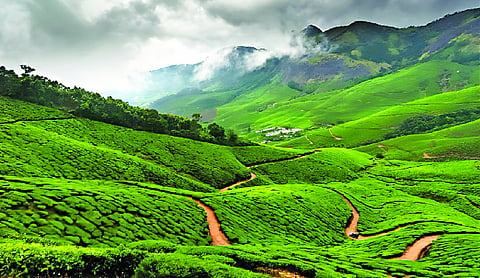

From pump storage projects in Maharashtra to rail and tunnel projects in Karnataka and Kerala, large-scale deforestation is threatening the fragile Western Ghats. Compensatory plantations cannot replace ancient forests, their biodiversity or their critical role in sustaining the subcontinent’s water cycle.
Torrent Power, through Torrent PSH 3 Private Limited, is developing 3000 MW Stream Open Loop Pump Storage Project over 377 ha land in Maharashtra's Karjat taluk, Raigad district. The project site includes 233 ha forest lands, with pristine forest covers of Western Ghats. The enumeration of the tree cover shows that there are 33 thousand trees on forest lands, which are proposed to be sacrificed for the sake of the project. Two artificial reservoirs are to be constructed. The lower reservoir is proposed across Pej, a tributary of River Ulhas, and the upper reservoir is located west of it, indicating that the tunnel connecting the two runs from west to east. The environmental clearance and stage I forest clearance have already been granted to the project.
There are serious environmental concerns with regard to the diversion of the forest land, loss of biodiversity, loss of carbon sequestration potential and the ecological services these forests provide. Furthermore, the deforestation would result in compromising the strength of transport of moisture-laden air from the surface of the Arabian Sea to deep inside peninsula and Central Indian landscape.
Keralam, Karnataka and Maharashtra share a sizable portion of Western Ghats supporting the best forests of the country. The entire region has been facing the fury of nature; the landslides, landslips and drought with increasing frequency. Barely 5 km from Wayanad's 2024 Mundakkai-Chooralmala landslide that had buried more than 300 people under the debris, it rained incessantly and repeated the tragedy in July 2026 by bringing down massive torrent of mud and debris thundering downhill towards Meenakshi river shallowing the people, vehicles and machineries in its path. When the tragedy occurred this time, a twin tunnel project cutting through Vellarimala mountain range to connect Kozhikode and Wayanad districts was under execution by Konkan Railway Corporation. This project was in the pipeline, when the 2024 tragedy had struck, and experts had advised not to implement it as the region is vulnerable for landslide. Yet, State went with it and even the Supreme Court granted a go-ahead this year.
Karnataka, too, is implementing a number of projects in the Western ghats region, where large scale deforestation is on card. The most damaging among these being Sarvathy Pump storage project and Hubballi Ankola rail project. Lakhs of trees in the pristine forests deep inside western ghats are facing axe. Deforestation is linked to declining precipitation. What is intriguing here is that scientists from the local institutions like Indian Institute of Science Bengaluru (IISc) and National Institute of Advance Studies, Bengaluru (NIAS) have extended support for the large-scale deforestation projects. Hubballi Ankola rail project has received the support of IISc Scientist Ramchandra, who believes that the same quality forests can be regenerated if the area is provided with chain-link fencing and additional proper inputs. Ramchandra's belief is highly misplaced and he should not support the deforestation of natural forests in the Western Ghats. Similarly, NIAS's scientists have committed a blunder in recommending Saravathy Pump Storage project in Shivamogga and Uttara Kannada districts of Karnataka. This project is under litigation for a long time and at some stage the National Board for Wildlife (NBWL) appointed a committee headed by Dr HS Singh, a retired PCCF, Gujarat and comprising of II Sc ex Scientist Sukumaran and a NTCA representative to visit the site and interact with all stakeholders. The committee in due course, reported to reject the proposal. NBWL, in turn, asked NIAS to study the project afresh and come up with a report. NIAS's study report, which is funded by a developer, recommends the project again. The projects are environmentally and economically devastating.
Two Physicists named A M Makarieva and V G Gorshkov from St Petersburg Nuclear Physics Institute, Russia, conducted a study and came up with a paper titled "Biotic pump of atmospheric moisture as driver of the hydrological cycle on land", which was published in "Hydrology and Earth System Sciences" on 27th March 2007. It has been observed that water from the land flows to oceans under gravity and the loss of water from land is continuously compensated by atmospheric transport of moisture from ocean to land. Using data from terrestrial transects, the Physicists have found that air fluxes can transport moisture over non-forested areas for a few hundred kilometers; precipitation decreases exponentially with distance from ocean. In contrast, precipitation over extensive natural forests is independent of distance from ocean for several thousand kilometers. This explains the existence of an active biotic pump transporting atmospheric moisture inland from the ocean. The phenomenon is essentially explained as low level air moves from areas with weak evaporation to areas with intense evaporation. Due to high leaf area index, tropical evergreen forests maintain high evaporation fluxes, which support the ascending air motion over the forest and "suck in" moist air from the ocean, which is essence of biotic pump of atmospheric moisture, resulting in enhanced precipitation at any distance from the ocean. The evidences testify that an intense terrestrial water cycle is unachievable without extensive forests covering the width of the continent.
If the forests are to disappear, then moisture would no longer be sucked in, and given the natural fallout rate of rainfall, some 600 kilometers from evaporation to precipitation, the land would dry out and turn into desert. We must save our forests. I want to flag two more issues to dismiss the argument that we grow compensatory afforestation in lieu of the forests lost and also whether the loss is limited to the trees enumerated by the Forest Department. Most project proponents and supporters justify the project's economic viability after paying for the net present value of the forests, which has been fixed as Rs 9 to 18 lakhs per ha and also after making an additional payment of cost of growing compensatory afforestation on non-forest lands.
Forests in the Western Ghats are normal forests, where trees of all age classes are present. If the Forest Department has enumerated 33 thousand trees on 233 ha forest land being sacrificed for Saidongar, Karjat pump storage project, there would be ten times this number in the form of saplings and pole crops, below 12 cm girth at breast height, which have not been brought on enumeration list. It is not only 33 thousand big trees facing the axe, additional 3 lakhs saplings and pole crops will also be pulled down to make way for the implementation of the project.
Western Ghats forests are the most productive and rich in biodiversity. There are more than 300 floral species, which house substantial number of faunal species too. These are God's gifted forests and cannot be recreated by human being. We often select refractory areas for compensatory afforestation, which are located in poor agro-climatic zone and grow only a very few species, mostly exotics. Attempts made in growing other native species on degraded lands have been unsuccessful. Losing forests from a river catchment like the Western Ghats, and compensating it on a dry land far off, poses a challenge for management, too. The ecological services and carbon sequestration potential lost cannot be made up in compensatory afforestation. In reality, compensatory afforestation is no compensation for the loss.
The super El Nino of 2026-27 has suppressed the rainfall considerably and states like Maharashtra, Karnataka and Telangana are reeling under severe drought and June to September crops have wilted. The possibility of winter crops is also bleak, as the soil moisture and underground water level have depleted. In such a scenario, let us not deforest the Western Ghats.
Western Ghats forests are the most productive and rich in biodiversity. There are more than 300 floral species, which house substantial number of faunal species too. These are God's gifted forests and cannot be recreated by human being. We often select refractory areas for compensatory afforestation, which are located in poor agro-climatic zone and grow only a very few species, mostly exotics
BK Singh is retired head of Forest Force, Karnataka and teaches Economics in Karnataka Forest Academy; Views presented are personal.