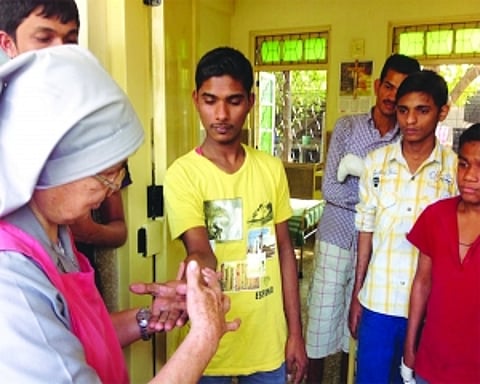

As India intensifies its Coronavirus vaccination drive, it can take a few lessons from DD’s leprosy campaign and help people overcome their vaccine hesitancy
Even for India, a country full of surprises and sensations, the specter of COVID-19 has left multiple scares. The Coronavirus pandemic marked the declension of the Indian way of life in three ways as it proved to be a setback in realising past dreams, acted as a present nightmare and tried its best to land our future in oblivion. Shame, stigma, separation, fear of suffering and death were the indices of people’s mental health.
Leprosy, the oldest known affliction to mankind, has always invoked a feeling of disgust and revulsion. Historically, it has been associated with scorn, rejection, seclusion and with untouchability. With India having the largest number of leprosy patients in the world, it was Mahatma Gandhi who began to nurse and host people afflicted by leprosy at his ashram. He had actively embraced inclusive principles and rejected the stigmatisation of persons suffering from this disease, asking: “Why should I call those my brothers if I do not mix with them?”
Wanting to pay homage to the life of Mahatma Gandhi and his death on January 30, 1948, the French humanitarian Raoul Follereau selected the date for observing World Leprosy Day. This was a tribute to Bapu’s work with leprosy patients. Since then, the day is observed on the last Sunday of January every year, though in India it is always observed on January 30, the martyrdom day of the Mahatma.
With India launching the world’s biggest vaccination drive against the raging Coronavirus pandemic, it may be apt to rewind to the year 2000 when Prasar Bharati — Doordarshan (DD) and Akashvani (AIR) — achieved a singular milestone in its campaign against leprosy elimination.
Alarmed by India being host to 66 per cent of all leprosy patients in the world and in pursuit of the 44th World Health Assembly resolution which committed member States to attain the goal of global elimination of leprosy as a public health problem by 2000, the Ministry of Health and Family Welfare (MoHFW) thought of launching a media campaign to address the prevailing prejudices and apprehensions about leprosy and to sensitise the people to opt for the multi-drug therapy (MDT) that had proven effective in combating the disease.
A year-long media campaign involving the Ministry, Prasar Bharati and BBC World Service Trust (now called BBC Media Action), the philanthropic arm of the BBC, armed with British Government funding, was launched in 2000. While DD and AIR were responsible for providing programme design and the creativity, planning, strategy, creative personnel, equipment, studios, free broadcast time for spots and advertisements and programmes, the BBC arranged for research, workshops, training, logistics and so on. The MoHFW identified the thrust areas of the campaign and advised on policy issues and technical aspects of the disease.
The campaign was mounted in two phases from five DD kendras and several AIR stations for the five worst-affected States of Bihar, Madhya Pradesh (MP), Odisha, Uttar Pradesh (UP) and West Bengal. In the first phase, that is, January-March 2000, as many as 23 spots were produced for telecast by DD whereas AIR made and broadcast 140 jingles. While the second phase (June-August) saw 12 dramas, four documentaries, two interview programmes and one live event being hosted on DD, the AIR broadcast an eight-part series, musicals and phone-in programmes in Hindi and regional languages. This translated into 22 hours and 31 minutes of airtime on DD and 266 hours 48 minutes on AIR which in monetary terms amounted to about Rs 8 crore. The BBC, on the other hand, contributed Rs 2.7 crore toward the campaign out of the £1.1 million grant, with the remaining 65 per cent going to establishment costs, staff salaries, travel, entertainment and so on. At the end of phase 1 of the campaign, Roy, Head, Health Projects Director of BBC World Service Trust, wrote a letter in May 2000 to DD stating: “The DD-BBC leprosy project has been an outstanding success. The independent (ORG Marg) audience research data we have just received shows, for example, that the number of people who believe that leprosy is hereditary has fallen from 81 per cent to 31 per cent in Bihar, and from 71 per cent to 26 per cent in MP over a three month period. These figures are simply extraordinary. I have been told by the World Health Organisation and by leading research institutions in the US that these results represent one of the most successful health campaigns to have taken place anywhere in the world, ever…this is a tremendous tribute to the outstanding work of the Doordarshan/AIR producers on the project.”
Without even waiting for the second phase to start, he went on to solicit an extension of the DD-BBC partnership for another health project —HIV/AIDS. Was this achievement accidental or conjured from thin air? Not that the good old DD had never created a “miracle” in the past. There were many in that league. For instance there was the year-long Satellite Instructional Television Experiment (SITE) project in 1975 covering more than 2,400 villages, the Asian Games in 1982 and the introduction of colour TV in India, the coverage of the Bangladesh War or earlier, the launch of School TV, Krishi Darshan, or even Zubin Mehta’s first concert to go live in India on DD in 1984, and which also marked an innovation in filming symphony concert on international TV, to name a few. But unfortunately, neither the country nor DD itself remembers these milestones. Ironically, what is remembered are the entertainment programmes which were not produced or created by DD itself. DD only provided airtime at a cost to private producers. The staff and internal resources were utilised for dishing out routine or “obligatory” programmes in a cycle of tireless repetition of exigency. A colleague in DD used to sneer, “We only attend to urgent matters, not the important ones.”
While drafting the memorandum of understanding (MoU), I was particularly conscious of the low morale of the overburdened creative staff, as no recruitment had taken place for over a decade. As such, certain clauses, particularly entitling the production teams to fly, stay in three or four-star hotels, reimbursement of expenses incurred by them during the project — perquisites that were sine qua non in most Indian channels, and considered de rigueur in international media organisations but not applicable in DD/AIR — were incorporated into the MoU. Moreover, extensive brainstorming, training and workshops by leading professionals and hand-holding by Peter Gill, and Lori McDougall of BBC World Service Trust helped the team members to come up with scintillating ideas, that too, in a range of genres — comedy, tragedy, suspense, mythology, folk drama, musical et al in a bid to demolish people’s misconceptions, beliefs, attitude and the stigma associated with leprosy.
Extensive research and field interviews with the victims of this scourge gave the producers an insight into the suffering, pain, trauma and a vehement feeling of rejection by society, resulting in loneliness.
Phase 2, which primarily had longer duration programmes and concentrated more on driving the message that leprosy is curable, created an even more positive influence on the viewers. In the end, DD bagged the Commonwealth Broadcasting Association’s Award for the best social action television programme in 2001 for its leprosy awareness and prevention campaign.
That was a proud day for all associated with the campaigns. Now, as India goes deeper into its Coronavirus vaccination drive maybe it can take a few lessons from this leprosy campaign on DD and AIR and help people overcome their vaccine hesitancy. Good old DD and AIR are always at the service of the nation.
The writer is a is Former Founding Executive Director, LSTV, and Additional Director General, Doordarshan. The views expressed are personal.