
Author: Waiel S H Awwad
From Washington’s confrontation with Tehran to the continuing war in Ukraine, recent developments expose the limitations of military solutions and underscore the need for political accountability, diplomatic engagement and negotiated settlements. India has an opportunity to reinforce this message through constructive diplomacy
The international order is facing a familiar but increasingly dangerous contradiction: military power is being projected as an instrument of political strength, while diplomacy is being called upon to manage the consequences. From Washington's confrontation with Tehran to the continuing war in Ukraine, recent developments reveal the limitations of military solutions and the growing importance of political accountability and diplomatic engagement.
Three developments deserve particular attention: the impeachment initiative against US Defence Secretary Pete Hegseth, President Donald Trump's continuing warnings to Iran, and Prime Minister Narendra Modi's renewed diplomatic engagement with Ukrainian President Volodymyr Zelensky. Taken together, they reveal how domestic politics, regional security and international diplomacy are becoming increasingly interconnected.
The question of accountability
President Donald Trump's public defence of Defence Secretary Pete Hegseth, whom he credits with having "won two wars", has not ended the controversy surrounding the administration's military campaign against Iran.
Republican Congressman Thomas Massie has introduced eight articles of impeachment against Hegseth, accusing him of violating the War Powers Resolution, conducting military operations without congressional authorisation and failing to uphold legal safeguards intended to protect civilians during armed conflict. These remain allegations to be considered through the constitutional process, not established findings. The initiative could force a House vote within days.
The significance of this development extends beyond the political future of one cabinet official. It raises a fundamental question about the constitutional limits of presidential power and the role of Congress in authorising military action.
The American Constitution gives Congress the power to declare war, while the president serves as commander-in-chief. The War Powers Resolution of 1973 was designed to prevent prolonged military engagements without congressional approval. The dispute over Iran therefore touches the very foundations of the American system of checks and balances.
The political context is equally important. The Republican Party suffered substantial losses in the November midterm elections, with the Iran conflict and the cost of living emerging as major sources of voter dissatisfaction. The incoming Congress is expected to intensify scrutiny of the administration's decisions. Trump may continue to defend his military strategy, but the question facing Washington is increasingly difficult: can a president claim success abroad while confronting growing demands for accountability at home?
Military pressure without a political solution
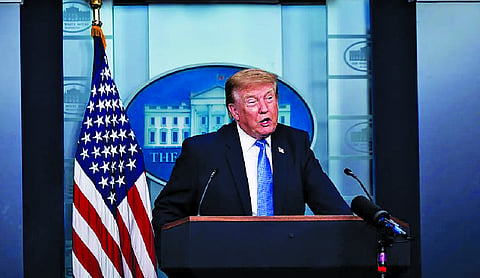
Trump's approach to Iran illustrates another contradiction in contemporary American foreign policy. Washington insists that Iran must never acquire nuclear weapons, while maintaining the threat of renewed military action.
The president has claimed that Iran's nuclear capabilities have been severely degraded and has described American forces as "locked and loaded". Yet, in his latest remarks on November 9, he indicated that renewed attacks were "quite unlikely", suggesting that the conflict could be moving towards an end. He also said that the United States remained prepared to act if circumstances changed.
This shift in emphasis is significant. It suggests that Washington is weighing the risks of further military escalation against the possibility of securing a political arrangement through negotiations and continued economic pressure.
But military superiority does not automatically translate into a sustainable political outcome. Even if military operations have significantly damaged nuclear infrastructure, they cannot eliminate the political disputes, strategic mistrust and security concerns that underpin the confrontation.
The question is not simply whether Iran's nuclear programme has been weakened. It is whether a credible framework can prevent renewed proliferation concerns, establish regional security arrangements and provide assurances against another cycle of military confrontation.
The consequences extend well beyond Washington and Tehran. The security of the Strait of Hormuz, global energy markets, maritime trade and the economies of developing countries remain directly exposed to instability in the Gulf.
For India, which has substantial energy, trade and diaspora interests across West Asia, another escalation would carry serious economic and strategic consequences. The priority must therefore be a durable diplomatic settlement rather than an indefinite military standoff.
Preventing nuclear proliferation is a legitimate international objective. However, it must be pursued through verifiable agreements, diplomacy and international mechanisms rather than an assumption that military force alone can resolve the problem.
Ukraine: India's diplomatic opening
While Washington and Tehran remain entangled in the consequences of confrontation, New Delhi is seeking to reinforce the case for dialogue on another major international conflict. Prime Minister Narendra Modi spoke with Ukrainian President Volodymyr Zelenskyy on 9 November, reaffirming India's position that the conflict must be resolved through dialogue and diplomacy. Modi conveyed India's readiness to contribute to efforts aimed at a peaceful settlement.
The timing is important. The conversation took place ahead of US-mediated Russia-Ukraine discussions scheduled in Abu Dhabi on 10 and 11 November, the first such trilateral meetings in several months. Zelensky also raised the issue of Black Sea grain exports and indicated that India could help facilitate food corridors. This presents New Delhi with an opportunity to translate its diplomatic relationships into practical initiatives. India maintains longstanding ties with Moscow while expanding its engagement with Kyiv and retaining a strategic partnership with Washington. Its diplomatic approach has consistently emphasised dialogue without abandoning its own national interests. However, India's potential role should be assessed realistically. It cannot impose a settlement on either Russia or Ukraine, nor can it replace the principal negotiating parties. Its contribution would be most effective in areas where practical cooperation is possible: humanitarian assistance, food security, maritime corridors, confidence-building and reconstruction.
The Black Sea issue is particularly relevant. Disruption of grain exports affects not only the parties to the conflict but also food-importing countries across Africa, Asia and the wider Global South. A credible food corridor initiative could therefore provide a practical starting point for wider confidence-building. India's diplomatic value lies partly in its ability to maintain communication with countries that have increasingly difficult relations with one another.
Three conflicts, one lesson
The developments in Washington, Tehran and Kyiv reveal a broader reality about international relations: military power can alter the balance on the battlefield, but it cannot independently deliver political legitimacy, lasting security or reconciliation. For the United States, the Iran conflict has become both a foreign policy challenge and a domestic political controversy. The dispute over Hegseth demonstrates that military decisions cannot remain insulated from constitutional scrutiny and public accountability. For Iran, the challenge is to address international concerns over its nuclear programme while avoiding further isolation and military confrontation. For Ukraine and Russia, the possibility of renewed negotiations offers an opportunity, but a sustainable settlement will require difficult compromises and credible security guarantees. For India, the moment presents both an opportunity and a responsibility. New Delhi must protect its strategic autonomy, safeguard its economic interests and continue advocating diplomatic solutions without overstating its capacity to mediate. The world does not need another demonstration of military strength. It needs political leadership capable of translating power into a negotiated outcome.
Ultimately, the measure of leadership should not be how many military operations a government can claim to have won, but whether it can prevent the next war. The real test of power is not the ability to start a conflict or dominate its battlefield; it is the wisdom to bring it to a sustainable end.
Trump's approach to Iran illustrates another contradiction in contemporary American foreign policy. Washington insists that Iran must never acquire nuclear weapons, while maintaining the threat of renewed military action. The president has claimed that Iran's nuclear capabilities have been severely degraded and has described American forces as "locked and loaded". Yet, in his latest remarks on November 9, he indicated that renewed attacks were "quite unlikely", suggesting that the conflict could be moving towards an end.
The writer is a International award winning political analyst; Views presented are personal.