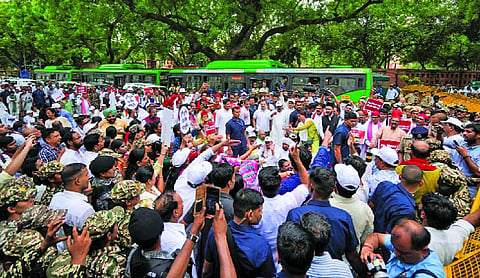

India is witnessing an unsettling contest in which political opposition increasingly risks being reduced to a competition in disruption. The Congress and the Cockroach Janata Party (CJP) appear to be converging on a common strategy of street mobilisation, confrontation with constitutional institutions and relentless amplification of allegations. The question is no longer merely whether the Opposition can challenge the government, but whether it is willing to respect the democratic processes through which governments are elected and disputes are resolved.
The BJP’s recent by-election victories in Assam and West Bengal, including in minority-dominated constituencies, have challenged entrenched political assumptions. These results reaffirm that voters cannot be taken for granted. Faced with a BJP that continues to demonstrate electoral resilience, the Opposition appears increasingly tempted to substitute street spectacle for a persuasive political alternative.
The examples of Nepal and Bangladesh offer a cautionary tale. Rahul Gandhi has previously invoked youth-led upheavals abroad while addressing young Indians. But India is a constitutional democracy with an elected Parliament, an independent judiciary and established mechanisms for peaceful political change. Importing the vocabulary of street-driven regime change into Indian politics risks blurring the distinction between democratic protest and destabilisation. Disruption cannot become a substitute for democratic persuasion.
Consider Rahul Gandhi’s reported remarks following his interaction with the President. Expressing surprise that the President had not rebutted his allegations of vote theft after receiving a memorandum betrays a fundamental distinction: receiving a representation is not the same as endorsing its contents. Constitutional office-holders routinely receive memoranda without certifying the claims they contain. The President’s courtesy cannot be converted into an implied admission of the Opposition’s allegations.
This is not the first controversy involving Rahul Gandhi’s interpretation of constitutional institutions. His earlier remarks concerning the Supreme Court’s Rafale proceedings led to an apology. Political leaders have a responsibility to distinguish between allegations, demonstrable facts and what constitutional authorities have actually said. Repeating an accusation does not make it true. The present protests raise another troubling question: why escalate street mobilisation when the Special Intensive Revision (SIR) of electoral rolls is already under the Supreme Court’s scrutiny? If the Opposition possesses compelling evidence of electoral wrongdoing, it should present it before the Court. If the Election Commission’s explanations are inadequate, the shortcomings must be demonstrated. The judicial process must be allowed to run its course.
By seeking to amplify political pressure while proceedings are under way, the Opposition risks creating the impression that it is more interested in shaping the public narrative than awaiting judicial findings. A courtroom is where evidence is tested; the street cannot become an alternative route to a judicial outcome. Constitutional institutions must be permitted to function without being overshadowed by political brinkmanship.
The Modi government was justified in taking firm action to prevent demonstrations from degenerating into a law-and-order crisis in the national capital. Governance requires prevention, not merely a response after disorder erupts. When protesters threaten to breach barricades, obstruct essential routes or disrupt public institutions, the administration cannot remain a passive spectator.
Delhi is not an open-air political theatre available for indefinite occupation by any party seeking confrontation. It is the capital of the Republic, where hospitals, courts, schools, offices, transport networks and diplomatic missions must continue to function.
Millions of ordinary citizens cannot be made collateral damage in a partisan political contest. The police have a duty to maintain public order, enforce lawful restrictions and prevent foreseeable escalation. The claim that every firm police response constitutes an assault on democracy distorts the relationship between liberty and responsibility. The right to protest is not a licence to paralyse public life, disregard lawful orders or compel constitutional institutions to submit to street pressure. Peaceful democratic engagement is welcome; disorder and unlawful obstruction must invite firm, lawful action.
Social media has made this challenge more acute. Viral videos, slogans and short-form content can create an impression of certainty long before evidence is examined. From the Citizenship Amendment Act to reservation policies and now electoral-roll revision, complex issues have repeatedly been reduced to inflammatory narratives. Young Indians deserve facts and context, not to be mobilised through misinformation for the political ambitions of others.
The costs of perpetual agitation extend beyond law and order. India is investing in infrastructure, manufacturing, energy security and technological competitiveness. Where is the Opposition’s credible roadmap for employment, economic growth and preparing young Indians for an economy transformed by artificial intelligence? When every institutional disagreement becomes a conspiracy and every administrative action is portrayed as repression, substantive debate is crowded out by manufactured outrage.
Public patience, too, has limits. Citizens have jobs to reach, schools to attend, businesses to run and families to care for. Public spaces belong to everyone, not exclusively to professional political protesters. When agitation becomes an end in itself, it ceases to serve the public and begins imposing costs upon it.
India needs an Opposition that scrutinises the government, exposes wrongdoing and offers credible alternatives. But criticism must be backed by evidence, allegations must be established and political mobilisation must remain within the boundaries of democratic responsibility. No party can claim a monopoly over democracy or demand that constitutional rules be suspended whenever they become inconvenient.
India stands at a decisive inflection point. The Viksit Bharat mission requires institutional confidence, sustained economic momentum and a national focus on the opportunities ahead. The country cannot afford to have its aspirations derailed by a politics of perpetual confrontation. The choice before India is between democratic competition that strengthens institutions and a politics that risks weakening them through relentless disruption. A confident democracy accommodates dissent while enforcing the law. It does not confuse anarchy with accountability. Viksit Bharat cannot be built by paralysing the present. It must be built by debating the future-and refusing to let the politics of anarchy derail the aspirations of a nation.