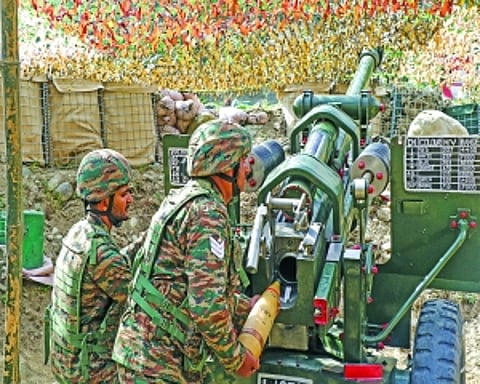

In a stunning display of technological prowess and strategic clarity, India’s Operation Sindoor reshaped the contours of modern conflict by compelling Pakistan to request a ceasefire within just 80 hours
The sudden ceasefire request by Pakistan within 80 hours of India’s decisive Operation Sindoor left many analysts and strategists stunned. Pakistan had abruptly called off its own military operation, Bunyan Marsoos (“Wall of Lead”), signaling a white flag in what was expected to be a protracted escalation. What caused this rapid turnaround? The answer lies in the Indian Air Force’s (IAF) precision strikes on Pakistan’s most secure military assets — especially their deeply buried command and control centres at key airbases. These surgical strikes shattered Pakistan’s operational capability and broke their will to continue hostilities.
The flashpoint for Operation Sindoor was the horrific terrorist attack in Pahalgam — the deadliest since the 2019 Pulwama bombing. This attack was claimed by The Resistance Front (TRF), a proxy terror outfit linked directly to Lashkar-e-Taiba (LeT), which enjoys overt support from Pakistan’s establishment. Despite global condemnation, Pakistani Prime Minister Shahbaz Sharif and their Army Chief remained unapologetic and silent on state — sponsored terrorism.
India’s response was swift and calculated. Since the 2019 Balakot airstrikes, the IAF had refined its doctrine of striking terror infrastructure deep inside Pakistan with surgical precision, backed by highly accurate intelligence. This time, nine terror-related targets were hit, including the JeM’s training academy at Bahawalpur and LeT’s headquarters at Muridke.
The Pakistani retaliation was brutal but ineffective: drone attacks, shelling border villages, and failed attempts by the Pakistan Air Force (PAF) to target Indian military bases. India, in turn, struck back with coordinated attacks on Pakistan’s air defense radars, surface-to-air missile (SAM) sites, integrated air defense systems (IADS), and other critical PAF installations at 13 locations. These strikes were not just tactical but demonstrative — designed to showcase India’s technological edge and disrupt Pakistan’s ability to respond or escalate further.
Targeting Pakistan’s Hardened Deeply Buried Targets (HDBTs)
One of the most critical aspects of these strikes was the destruction of Pakistan’s Hardened Deeply Buried Targets (HDBTs). These underground military complexes are designed to withstand aerial and even nuclear attacks. Militaries worldwide dig deep to protect their critical command, control, communications, and intelligence (C4I) centres from enemy strikes.
Pakistan’s network includes at least 22 such underground bunkers around its major airbases and strategic cities like Islamabad and Karachi. These facilities are reinforced with multilayer concrete, steel rebar, and equipped with advanced heating, ventilation, and air conditioning (HVAC) systems to sustain prolonged occupancy underground.
During Operation Sindoor, the IAF successfully struck two vital HDBTs: one at Chaklala (now Nur Khan) Airbase near Islamabad, and another at Murid Airbase on the Pothohar Plateau. According to the Indian Director General of Military Operations (DGMO) Air Marshal A.K. Bharti, these were command and control air defense centres — but the author contends they functioned more broadly as C4I nerve centres, integrating radar data, intelligence feeds, and coordinating air operations.
The Chaklala Airbase Strike: A Technical Masterclass
The underground facility at Chaklala was built in the 1990s by General Electric Aviation, a US company specialising in subterranean military infrastructure. It spanned roughly 750 square meters and was considered one of Pakistan’s most advanced air defense hubs. In fact, VIPs and foreign military delegations frequently toured this bunker to marvel at Pakistan Air Force’s indigenous technological integration.
The IAF’s strike on Chaklala was a demonstration of extraordinary precision. Satellite imagery revealed the bomb entered through a tiny HVAC shaft barely 45 centimeters wide — an incredibly small target given the best satellite resolution of 30 cm per pixel. This meant zero margin for error, requiring perfect intelligence, exact coordinates, and probably the deployment of the best pilots and weaponry available.
The bomb’s explosion was so powerful that it blew a large chunk of the concrete roof into the air, pulverising the entire facility underground and everyone inside instantly. Following the strike, Pakistan took days to clear debris, eventually deciding to bury the remains of fallen personnel in situ since nothing else remained. This strike was likely the first of its kind in aerial warfare history — hitting such a tiny and deeply buried target with pinpoint accuracy and total destruction.
Overcoming Advanced Defences
Murid Airbase’s underground facility was even more sophisticated. Pakistan’s Special Works Department had learned from earlier constructions and implemented advanced countermeasures — extending HVAC shafts away from the facility to prevent precision strikes via ventilation ducts.
Faced with this challenge, the IAF adapted its tactics, opting to strike the central section of the bunker directly. Post-strike satellite images revealed a small, sharply defined crater consistent with a deep penetrating bomb exploding underground, not on the surface. The light color of the crater edges confirmed it was an impact crater with the explosion occurring deeper below.
Imagery showed a large truck stationed at the entrance, likely involved in salvage or recovery operations, and a lone ambulance nearby — suggesting at least one survivor but significant casualties among airbase personnel. Pakistan quickly cemented the crater to obscure evidence from overhead satellites.
Strategic Implications and Aftermath
Pakistan’s attempts to shield critical command centres underground were foiled spectacularly by Indian ingenuity, intelligence, and precision weapons. The destruction of these two HDBTs, alongside other strikes at Sargodha and Jacobabad airbases, crippled Pakistan’s air defense command and air operations infrastructure for months.
Further satellite imagery revealed additional bunkers, including one near Islamabad International Airport believed to protect the PAF Chief of Air Staff (CAS). Despite fortifications added as recently as March 2025, these too were rendered ineffective.
This lack of functioning C2 nodes meant Pakistan’s air operations became fragmented and ineffective. Orders from the CAS could not reach field commands or aircraft, severely degrading Pakistan’s ability to wage aerospace warfare or activate nuclear options.
A Calculated yet Devastating Message
The IAF’s strikes were meticulously calibrated to avoid triggering Pakistan’s nuclear threshold, while still delivering crippling blows to Pakistan’s military infrastructure. The destruction was so complete that Pakistan had no face — saving nuclear option, yet the scale of damage forced them to seek an early ceasefire to prevent further humiliation.
India also took a strong diplomatic stance, suspending the Indus Water Treaty and cutting water flow to Pakistan until it ceases support for terrorism. This multi-domain pressure — from aerial strikes to economic leverage — exemplified a new, integrated approach to national security.
Conclusion: The Unseen Triumph
The world was largely silent on the satellite evidence, but India’s demonstration of air power during Operation Sindoor was unprecedented in modern warfare. Within barely 80 hours, the IAF achieved what many believed impossible: obliterating the backbone of Pakistan’s air defense and command capabilities underground, and forcing a reluctant adversary to call a halt to hostilities.
The strikes at Chaklala and Murid airbases remain benchmarks of precision, intelligence fusion, and technological excellence. These operations showcased India’s ability to blend advanced ISR (intelligence, surveillance, reconnaissance) assets, superior weapons technology, and tactical innovation — sending a clear message that aggression backed by terrorism will meet with swift and decisive consequences.
This episode in modern conflict underscores a new paradigm of aerospace warfare, where intelligence accuracy, technological superiority, and surgical strikes dictate the outcome before full-scale battles even begin. For India, Operation Sindoor was not just a military success but a strategic victory that restored deterrence and sent an unequivocal warning to Pakistan and the world.
(The writer is a retired Colonel of the Indian Army. Views expressed are personal)