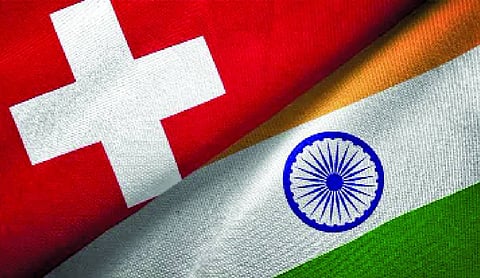

The foundation of India-Switzerland diplomatic relations was laid on 14 August 1948, when the two countries signed the Treaty of Friendship in New Delhi, one of independent India's earliest bilateral agreements. The partnership rested on shared commitments to democracy, neutrality and multilateralism. In the post-independence years, the role of Swiss technical cooperation made an important contribution to India's efforts towards modernisation, notably through institutional partnerships in vocational education, dairy development (including support for the National Dairy Development Board) and precision engineering. Swiss support was pivotal to the foundations and success of India's White Revolution and the cooperative model that transformed the country into a global milk producer. In the next decades, bilateral engagement gradually shifted from the early set of developmental assistance from Switzerland to new kinds of commercial exchanges and the expansion of cultural affinity. Switzerland entered the Indian popular consciousness through the lens of Bollywood cinema during the late 1980s.
Swiss enterprises recognised India's market potential early, establishing high-precision manufacturing, chemical and food-processing facilities across the country. Notable names among them were Ciba (a predecessor of Novartis, 1947), Nestlé, which opened its first manufacturing plant in Moga, Punjab, in 1961, and leading engineering and precision firms such as Brown Boveri (now ABB), Sulzer, Rieter, Schindler and Oerlikon-Bührle, which set up and further expanded operations in the 1950s across India. Between 1957 and 1982 alone, the Indian government approved more than 380 technical and industrial cooperation agreements with Swiss companies to boost industrial capacity-building and promote technology transfer in these key sectors.
However, for much of the last century, the dynamics of Indo-Swiss bilateral relations remained cordial and dependable, but with less strategic coherence and convergence.
After 2014, under the leadership of Prime Minister Narendra Modi, this bilateral relationship has witnessed an institutional transformation. High-level exchanges and leadership visits define these new shifts and changes in mutual understanding. The bilateral dialogue is now more closely linked to core economic and strategic deliverables.
Looking beyond traditional diplomacy, Modi's leadership focused on building fiscal transparency and mutual legal assistance mechanisms with Switzerland to ensure tax transparency. In this context, the operationalisation of the Automatic Exchange of Information (AEOI) framework marked a watershed moment, demystifying Swiss banking secrecy and creating systemic channels to counter illicit financial flows. Also important was the repositioning of the bilateral agenda around Make in India, high-speed mobility and India's push for new and quality public infrastructure.
Swiss engineering and technical expertise found a role in building modern infrastructure in India, such as Noida Jewar International Airport, Himalayan rail tunnelling and the development of urban ropeway systems. Built by Swiss researchers, Noida International Airport in Jewar has become the first large-scale project in India to use Limestone Calcined Clay Cement (LC3), a low-carbon alternative to conventional cement, making it one of the largest eco-friendly urban infrastructure projects in the country. During the recent visit of Swiss Confederation President Guy Parmelin to New Delhi, the India-Switzerland partnership received a significant boost in multiple areas. This also marked the first anniversary of the India-European Free Trade Association (EFTA) Trade and Economic Partnership Agreement (TEPA), signed last year. Unlike conventional free trade agreements focused strictly on tariff cuts, TEPA is built on an investment-linked compact. Both leaders emphasised turning the agreement's commitments - USD 100 billion in investment and one million direct jobs in India over 15 years - into more concrete outcomes in trade, technology and talent. Concluded after nearly 16 years of negotiations, the TEPA agreement secures easy market access for Indian exports across high-income European economies. For Switzerland, the deal provides predictable tariffs while opening up integration into India's economic development and expanding domestic supply chains.
The recent three-day visit by Swiss Confederation President Guy Parmelin to India, which also culminated in the second anniversary of the India-EFTA Prosperity Summit at Bharat Mandapam on 7 October, remained significant and valuable for the bilateral relationship.
Firstly, with the deepening economic and trade partnership under TEPA, the new agreement expands market access for Indian exports in agriculture, pharmaceuticals, textiles and engineering goods. This is reciprocated by increasing Swiss investments in biotechnology, life sciences, banking, insurance, food processing and sustainability. The Prosperity Summit provided a platform for industry leaders to convert policy commitments into ground-based actions and projects.
Secondly, both sides acknowledged the importance of enhanced cooperation in technology, innovation and artificial intelligence, building new collaborations in technology-driven green electric mobility and clean energy security. India supported Switzerland's hosting of the next global AI Summit in Geneva in June 2027.
Thirdly, both sides agreed on easy and smooth procedures to safeguard talent mobility and people-to-people ties. The Migration and Mobility Partnership Agreement (MMPA) enables multiple-entry visas valid for up to five years and renewable one-year student permits. The Young Professionals Agreement provides for an annual exchange of 300 participants from each country. These new steps will strengthen Indo-Swiss education, research and professional linkages. They also agreed on advancing Swiss expertise in precision engineering models to complement India's infrastructure push and green transition goals.
The bilateral dynamics between India and Switzerland are positioning themselves towards more strategic, industry-driven economic cooperation. Given geopolitical instabilities, rising tariffs and new tendencies towards trade weaponisation, India and Switzerland together can act as complementary middle-power stabilisers for global trade. The evolving framework of Middle Power Strategic Alignment between them allows new scope for opportunities and partnership to diversify external dependencies, reinforce multilateral governance and secure resilient technology ecosystems. As the two countries approach the 80th anniversary of diplomatic relations in 2028, the Prosperity Summit has directed this partnership towards broader, future-oriented collaboration grounded in shared prosperity, innovation and mutual trust.