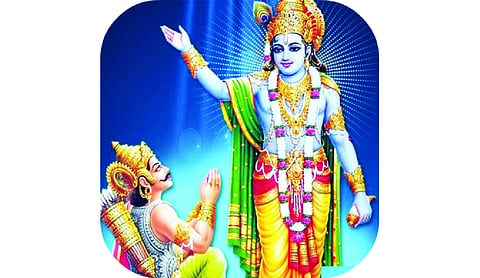

Author: Dr Krishna Bhatta
Chapter 1 - Check Your Perspective: The situation may be the same, but how you see it shapes your thoughts, emotions, body, and ability to act. Duryodhan sees an opportunity to win on the battlefield of Kurukshetra. Arjun sees the people he may have to kill. The same battlefield fuels confidence in one and leaves the other paralyzed.
The Trap of a Single Lens
The battlefield is the same for everyone. The armies are assembled, conches are sounding, and war is about to begin. Yet Duryodhan and Arjun experience the moment very differently.
Duryodhan: A Perspective That Fuels Confidence
Duryodhan surveys the opposing army and approaches the situation as a contest of strength. He compares the two armies and declares:
“Our army, protected by Bhishma, is immeasurable; their army, protected by Bhim, is limited.”
Duryodhan sees strength on his side and measures the opposition through the lens of military advantage. His attention is fixed on the contest ahead, reinforcing his confidence as he prepares for battle. His perspective fuels his determination to fight.
Arjun: A Perspective That Leads to Paralysis
Arjun asks Krishna to place his chariot between the two armies so he can see those assembled for battle.
“Place my chariot between the two armies, O Achyuta.”
But when Arjun looks at the opposing side, he no longer sees just an army. He sees his grandfather, teachers, relatives, and friends.
His attention shifts from the battle ahead to the personal relationships at stake and the suffering he anticipates. The consequences are immediate. His body trembles, his mouth dries up, and his skin burns. His bow, Gandiva, slips from his hand.
“My bow slips from my hand, and my skin burns.”
Arjun loses the will to fight. He sits down in his chariot, overwhelmed by the conflict within him. His perspective has affected his entire being: his thoughts, emotions, physical state, and capacity to act. The battlefield has not changed. But how the two men see it shapes how they experience it-and how they respond. This does not mean that Duryodhan is right or that Arjun’s concerns are without merit. Rather, the contrast reveals how our perspective can profoundly influence our state of mind and behavior.
The Insight
We face our own Kurukshetras every day.
A difficult conversation with a colleague. A disagreement within the family. An unexpected financial setback. A decision that could change our future.
The circumstances may be identical, yet people can respond in entirely different ways.
One person sees a challenge and feels motivated. Another sees the same challenge and feels threatened. One sees an opportunity to learn; another sees the possibility of failure.
Our perspective influences not only what we think but also what we feel, how our body responds, and what we believe we can do.
When we feel threatened, we may become defensive or aggressive. When we become overwhelmed by possible consequences, we may hesitate, withdraw, or become paralyzed. We often assume that our interpretation is reality itself. We react to our assumptions as though they were facts and to our fears as though they were certainties. That is the trap of a single lens.
The Gita invites us to take a step back-not to deny reality or suppress our emotions, but to examine how we are seeing the situation before deciding how to respond.
Before asking, “What should I do?” ask, “How am I seeing this?”
What Do I Do Today? When a situation overwhelms you, use these three steps to examine your perspective before acting.
1. Pause Before You React
Arjun asks Krishna to position his chariot between the two armies. He wants to see the situation before him. Take a similar pause when emotions run high. Before sending that angry email, confronting someone, or making a major decision, give yourself time to step away from the immediate reaction. Breathe. Allow the initial surge of emotion to settle. Look at the situation from a little distance. You do not need to solve everything immediately. First, create the space to see more clearly.
2. Examine Your Lens
Ask yourself: “Am I seeing this through the lens of ego, pride, or the need to win?
“Am I overwhelmed by attachment, fear, or the possibility of losing something important? “Am I considering the whole situation, or focusing only on the part that confirms my concerns? Be honest about what is influencing you. Recognizing your perspective does not mean that your concerns are wrong. It means you are willing to examine them rather than let them dictate your response.
3. Separate Facts from Assumptions
When we are distressed, we often mix what has happened with what we fear might happen. Take a piece of paper and divide it into two columns. Facts: What has happened? What do I know for certain? Assumptions and Fears: What am I imagining? What outcome am I anticipating? What am I treating as certain even though it has not happened?
Look at the two lists separately. You may discover that some concerns are justified and require action. Others may be assumptions that need to be questioned. Then ask yourself: Given what I know, what is the next appropriate step? The goal is not to force yourself to think positively. It is to see the situation more completely, so you can respond with greater clarity. The Takeaway: Looks Can Be Deceiving. Imagine you are watching the two warriors on the battlefield. Who would you bet on?
Duryodhan has the numbers, the army, and the confidence. He looks ready to win. Arjun, one of the greatest warriors of his time, cannot even hold on to his bow. He has lost his composure and seems incapable of fighting. If you had to place a bet, wouldn’t you choose Duryodhan? Yet we know that appearances can be deceiving.
Confidence is not the same as clarity. Strength is not the same as wisdom. And the way someone appears in a moment does not determine the outcome.
The same is true in our lives. Someone who looks confident may not see the whole picture. Someone who feels overwhelmed may still have the capacity to find clarity and act wisely. When you face a difficult situation, don’t judge yourself-or others-by how things look in that moment. Pause. Check your perspective. Then decide what to do.
Dr Krishna Bhatta is an author, surgeon, and inventor. He lives in Bangor, Maine, where he works as a urologist (former chief) at Northern Light Eastern Maine Medical Center; Views presented are personal.