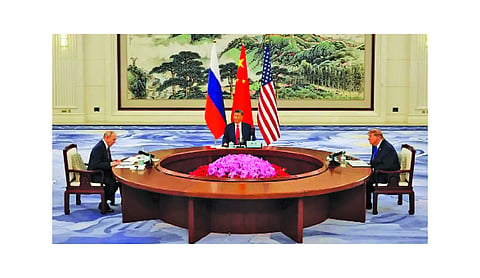

As Donald Trump, Xi Jinping and Vladimir Putin converge around the geopolitics of a changing world, the question is whether a world with multiple centres of power will become more equitable or merely replace one hierarchy with another
Yalta was not merely a meeting between influential leaders. It was a conference between three wartime allies with armies occupying vast territories. They were negotiating the political settlement of a world war. Franklin Roosevelt, Winston Churchill and Joseph Stalin met in Crimea in February 1945, as the defeat of Nazi Germany approached. Their discussions covered the occupation of Germany, the future of Poland, the organisation of the United Nations and the Soviet Union’s entry into the war against Japan. The Red Army already controlled much of Eastern Europe. The Western Allies could negotiate, but they could not reverse the realities created by Soviet military occupation.
The consequences of Yalta were partly shaped by the gap between what was promised and what followed. Poland was discussed without the participation of an independent Polish government capable of determining its own future. The declaration on liberated Europe promised representative governments and free elections. Yet the political arrangements that emerged in Eastern Europe increasingly came under Moscow’s control. The promises of democratic choice could not overcome the military and political imbalance on the ground. Roosevelt also deliberately kept the atomic project secret from Stalin.
Shenzhen is not Yalta. The three leaders meeting in China are not wartime allies dividing occupied territory. There is no equivalent of the Red Army advancing across Eastern Europe. Nor is there an agreed occupation map or public evidence of a secret settlement assigning countries to spheres of influence. The talks are taking place within an international system that includes the United Nations, sovereign states, regional organisations, international law and a much wider range of economic and diplomatic actors. Ukraine and Iran may be discussed, but discussion does not amount to a decision over their sovereignty.
Yet the comparison cannot be dismissed altogether. Ukraine is not expected to be represented in the trilateral discussions, despite being at the centre of the war launched by Russia. Iran is also absent, although the conflict involving it is among the issues Trump has indicated he wants to raise. European governments also have security interests in any settlement concerning Ukraine. The principle is straightforward. A peace agreement negotiated without a country’s meaningful participation may satisfy powerful capitals while leaving the underlying conflict unresolved.
The choice of Shenzhen is more than ceremonial. In 1984, Deng Xiaoping visited the Special Economic Zone and saw a city being constructed at extraordinary speed. He praised the slogan displayed in Shekou, ‘Time is money, efficiency is life’. His argument was that China needed to learn from foreign technology, management and knowledge to modernise. He described the special economic zones as ‘a medium for introducing technology, management and knowledge’. He also insisted that the policy was ‘to open and not to close’.
There is a significant difference between Deng’s message in 1984 and Xi’s address at the APEC CEO Summit this week. Deng was explaining why China needed access to the international economy. Xi now describes China as a ‘super-sized open market’ and calls for an ‘equality-based and orderly multipolar world’. He urges countries to ‘uphold the postwar international order’ and argues that ‘opening doors brings progress’. The change in language reflects China’s changing position. A country that once sought foreign investment and expertise is now a major source of manufactured goods, capital, technology and demand.
Xi’s message is more ambitious. China no longer presents itself simply as a country learning the rules of global commerce. It wants a role in shaping them. His call for a multipolar order challenges an international system in which power has traditionally been concentrated among Western economies. There is also an economic basis for this position. According to the World Trade Organization’s 2026 report on global trade, China remained the world’s largest merchandise exporter in 2025, with exports valued at approximately US$3.77 trillion, accounting for 14.4 per cent of global merchandise exports.
Putin’s address offered a different perspective. He described the Asia-Pacific as the ‘centre of the global economy’ and criticised what he called the methods of ‘former hegemons’. He called for ‘Equal, not hegemons; partnership, not isolation; dialogue instead of ultimatums’. For Russia, APEC offers an economic and diplomatic route towards Asia. Its relations with much of Europe remain severely strained by the war in Ukraine and Western sanctions. Putin’s emphasis on multipolarity also reflects Russia’s efforts to maintain its international influence.
The three leaders have different ambitions. Xi wants China recognised as a major architect of the emerging order. Putin wants to demonstrate that Russia cannot be economically isolated from Asia. Trump seeks commercial advantage, strategic leverage and a diplomatic outcome he can present as his own achievement. Their interests overlap in some areas and conflict in others. The planned meeting cannot be mistaken for an alliance or a settled agreement on the future of Ukraine, Iran or any other country.
Trump’s assault on Iran, Putin’s stated objectives of demilitarisation and denazification in Ukraine, and Xi’s pursuit of reunification with Taiwan are three distinct geopolitical projects. Each operates within a different historical and strategic context, involving different security interests, regional actors and, to varying degrees, proxy forces.
China’s economic rise is no longer a hypothetical development that other countries can choose to acknowledge or ignore. It is embedded in the production systems on which their economies depend. An Organisation for Economic Co-operation and Development (OECD) study published in November 2026 found that China’s share of foreign value added in world exports had risen from 3 per cent in 2000 to 11 per cent in 2024. It also found that China had become the largest foreign supplier in around 40 per cent of the country-industry relationships examined.
This makes the idea of simply containing China difficult to reconcile with commercial reality. Governments may restrict particular technologies, diversify critical supply chains, impose tariffs or screen investments on national security grounds. Some of these measures may be justified. However, an economic strategy based on removing China from the international system would impose substantial costs on other countries. China is a market, a manufacturing base, a technological competitor, a source of investment and a trading partner. Its importance cannot be legislated away.
This does not imply that countries are expected to accept Chinese policies, endorse Beijing’s positions or compromise their strategic independence. Economic engagement should not be conflated with political submission. China’s own conduct, likewise, warrants careful scrutiny. Its trade practices, restrictions on market access, industrial subsidies, technology policies and use of economic leverage remain legitimate subjects of examination. Multipolarity should not be interpreted as a justification for replacing one form of dominance with another. A world in which several powerful capitals exercise disproportionate influence over smaller states would hardly become more equitable simply by virtue of having a greater number of centres of power.
The contrast between Yalta and Shenzhen is also evident in the position of smaller countries. At Yalta, military occupation and wartime bargaining allowed three governments to make decisions with profound consequences for states that had little ability to resist them. In Shenzhen, influence is exercised primarily through markets, technology, capital, energy and trade rather than the division of occupied territory. This does not make contemporary power politics harmless. Economic dependence can constrain sovereignty, just as military pressure can. The mechanisms, however, are different, and the response must reflect that difference.
Deng’s Shenzhen was built on the proposition that a country could open its doors without abandoning its own interests. The question facing the rest of the world is whether it can apply the same principle. Shenzhen is not Yalta. Its significance will depend on whether the emerging international order allows countries to pursue their interests without leaving decisions about their futures exclusively in the hands of the most powerful.
Shenzhen is not Yalta. The three leaders meeting in China are not wartime allies dividing occupied territory. There is no equivalent of the Red Army advancing across Eastern Europe. Nor is there an agreed occupation map or public evidence of a secret settlement assigning countries to spheres of influence
The writer is a columnist based in Colombo; Views presented are personal.
