
Author: Sanket Oswal
Delhi has never lacked vision documents. Its weakness has been turning them into roads, homes and functioning neighbourhoods in reasonable time. The newly notified Master Plan for Delhi 2047 must be read against that history.
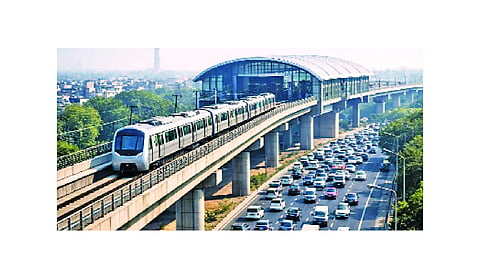
Covering 2026 to 2047, the plan sets out how the capital should grow over the next two decades. Its pillars are redevelopment, Transit Oriented Development (TOD), land pooling, high-density corridors and the planned expansion of peripheral areas. Together, they let infrastructure decide where and how intensively the city builds. The housing targets are ambitious. The plan expects roughly 20 lakh dwelling units to come through TOD and High Density Corridors: 18 lakh around Metro lines and 2 lakh along the corridors. The TOD zone now extends 500 metres on either side of Metro corridors and within a 500-metre radius of RRTS and railway stations. In these areas, FAR can go up to 500, and at least 65 per cent of housing must be affordable.
The logic is sound: homes near mass transit shorten the distance between living, working and travelling. Land pooling is the plan’s boldest bet on greenfield growth. About 20,000 hectares, close to 13.5 per cent of Delhi’s area, has been earmarked for planned development. The minimum scheme size has been cut to 20 hectares, multiple models for assembling land are permitted, and DDA will step in as a development anchor where landowner groups fail to coordinate. Nearly 600 kilometres of roads with a right-of-way of 30 metres or more are proposed, along with green spaces, utilities and public facilities. The early response, however, is a reality check. Landowners holding about 7,939.7 hectares, roughly 46.7 per cent of the target area, have expressed willingness to participate. The earlier Land Pooling Policy, notified in 2013 and revised in 2018, struggled to take off. Whether the new version’s flexibility translates into faster assembly on the ground will be a defining test of Delhi 2047.
Housing delivery is similarly mixed. DDA has built through 71 schemes and sold over 4.31 lakh flats. It allotted more than 11,764 flats in 2025-26 and sold 3,327 in the current financial year up to September 9, 2026. Yet around 2,00,600 units still await conversion from leasehold to freehold. That backlog sits uneasily beside the plan’s vast new targets. Delhi needs more homes, but also affordable, well-located ones, and a system that unlocks existing stock.
Redevelopment extends the same thinking to the existing city. Around 700 square kilometres have been identified for renewal, bringing ageing and underused areas to the centre of growth strategy. Done well, with adequate infrastructure and amenities, this could let Delhi house more people without endlessly pushing its boundaries outward. This requires a change in how the city views density.
Delhi has long equated density with congestion. The plan argues that density works when transport, roads, utilities and public amenities are planned with it. Hence its emphasis on a unified metropolitan transport planning mechanism, better last-mile connectivity, rationalised parking and infrastructure-led development. Coordination is where this could falter. DDA controls land and planning, but transport, water, drainage, sanitation and municipal services sit with several other agencies.
Approvals do not make a neighbourhood liveable; working roads, reliable transit, water, sewerage, schools and clinics do. The hardest task lies in neighbourhoods where people already live in poor conditions. DDA is the nodal agency for 376 JJ clusters on DDA and L&DO land, home to about 1.72 lakh dwellers. Only 4,967 have been rehabilitated or relocated so far. The plan seeks to expand in-situ rehabilitation by adjusting FAR and the balance between rehabilitation and remunerative components to make projects viable. For a family in a JJ cluster, the plan means something only when it yields a secure home, basic services and a manageable commute. On the environment, DDA manages about 16,807 acres of green spaces, including parks, biodiversity parks and the Yamuna floodplains.
Thirteen floodplain projects have been identified and a cycle track of over 52 kilometres is proposed along the river. The active floodplain will stay a no-construction zone, barring permitted recreation and essential utilities. A programme to revive 101 water bodies completed its first phase of dredging, excavation, desilting and catchment improvement on August 31, 2026. The second phase covers fencing, landscaping, making seasonal water bodies perennial and installing STPs or decentralised STPs where feasible. Success must be measured by outcomes such as groundwater recharge, flood resilience and public access, not activity.
DDA reports about 43.08 lakh plantations over five years, with the current drive being physically verified and geo-tagged. Less visible, but potentially transformative, is DDA’s digital overhaul. It is building databases of its land parcels with location, area, ownership status and geo-coordinates, and expanding online property and disposal services. Geo-referenced records can flag encroachments, and a Digital Twin could one day show planners how a change in one locality ripples across the city. Still, an un-updated record is an outdated record, and a dashboard has never built a road. The plan’s breadth reflects how tightly Delhi’s problems are knotted together: housing, mobility, land and environment all shape one another. For DDA, this demands a new level of institutional performance: winning over landowners, working with agencies it does not control, accelerating rehabilitation, selling housing where demand exists, completing land records and maintaining the assets it already holds.
The map has been redrawn. Whether the city changes depends on unglamorous execution, honest measurement and quick correction.
The writer is a lawyer and public policy professional; Views presented are personal.