
- HOME
- INDIA
- WORLD
- BUSINESS
- STATES
- LAW & JUSTICE
- ENTERTAINMENT
- SPORTS
- VIEWPOINT
- LIFESTYLE
- TECH
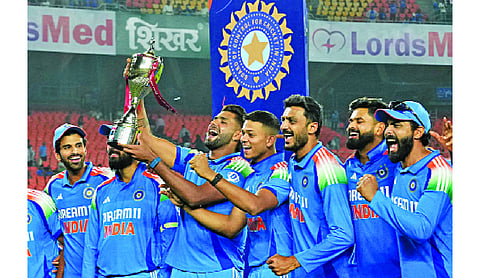
The BCCI's lavish payments to cricketers, coupled with questions over transparency and accountability in sports administration, highlight India's growing sporting inequality. Reforming cricket governance and redirecting public support towards neglected disciplines such as hockey are essential to building a more balanced sporting culture
It is indeed surprising that the Board of Control for Cricket in India (BCCI) is not a recognised National Sports Federation, and that giving salaries and pensions to cricketers is an internal matter for the BCCI. It should be declared a public authority under the RTI Act, as recommended by the Law Commission following a Supreme Court verdict. Huge amounts of public money are spent by the BCCI on salaries and pensions for individual cricketers and coaches. Vinod Rai, chairperson of the Supreme Court-appointed Committee of Administrators (CoA), tasked with ensuring the implementation of the Justice RM Lodha Committee report on the BCCI, warned on 03.07.2018 that the then election results of the Delhi and District Cricket Association (DDCA) could be annulled because of ethical and constitutional inadequacies.
He further pointed out that the elections had taken place without a constitution endorsed by the Supreme Court and that the DDCA had failed to put in place the Supreme Court-advocated checks and balances to avert possible conflicts of interest.
Elections witnessed an extraordinary amount of money being spent by groups contesting them. The elected DDCA chairperson had to resign after the unruly Annual General Meeting (AGM) held on 29.12.2019, with signatories refusing to sign hefty bills of `1 crore in legal fees for just one month and `90 lakh to spruce up marquee stands for a T20 International, against about one-third of the awarded tender.
For the convenience of candidates and voters, groups contesting all posts should be recognised by specific names, and group candidates may be numbered according to the alphabetical order of their group names, which should be placed at the top of the Electronic Voting System.
Independent candidates can be placed alphabetically after group candidates. Since voters are mostly literate, even a system of preferential voting can be implemented to avoid candidates winning because of a split in votes.
Necessary safeguards should be ensured for future elections to the DDCA or any other state-level cricket body so that the use of money power in campaigning may be restricted. Moreover, for the convenience of candidates and voters, groups contesting all posts should be recognised, particularly when many cricketers have annual salary packages of ` 7 crore (for a cricket coach, it is `10 crore), apart from hefty match and award money.
All direct and indirect facilities and funding provided by central and state governments should be given only to recognised sports federations. As such, these should be immediately withdrawn from the BCCI and its affiliated cricket bodies, which also include some government bodies apart from state cricket associations. However, the BCCI remains outside the purview of the RTI Act because heavyweight politicians cutting across party lines have deep administrative control over the BCCI and state cricket associations, despite not having played a single cricket match in their lifetimes.
The BCCI should totally abolish its policy of paying salaries and pensions to cricketers. Indian cricketers receive hefty match and award money, apart from their substantial income from commercial advertisements. If the BCCI does not stop the system of salaries and pensions for cricketers and coaches, the central government should take over the BCCI as part of the Department of Sports.
Sportspeople performing exceptionally well in other games have to lead miserable lives because of low incomes and the inability of their sports bodies to pay as much as the BCCI does. In no case should any cricketer be paid a salary or pension exceeding that fixed for the country's highest-paid bureaucrat. The BCCI must not have the right to spend funds generated by public enthusiasm on paying cricketers excessively.
The chairperson of Maruti once offered a practical suggestion that top managements should avoid paying obscene salaries to those at the top. Instead, there should be a formula whereby the highest-paid person in an organisation receives a maximum of 15-20 times the salary of the lowest-paid staff member. The same formula must apply to the BCCI. If the BCCI's earnings are the criterion for payments to cricketers, priests of famous temples could also demand hefty payments based on temple income. The central government should ensure that BCCI funds are utilised for public welfare schemes in the manner in which income from famous Hindu temples such as Tirupati is spent.
It is noteworthy that, despite Pakistani cricketer Shahid Afridi having made highly objectionable comments against India and the Indian Prime Minister, with Pakistani army personnel standing with him somewhere in Pakistan-occupied Kashmir (PoK), the Shahid Afridi Foundation's website continued to display messages of support from Indian cricket legend and Bharat Ratna Sachin Tendulkar. Later, Yuvraj Singh and Harbhajan Singh withdrew their support messages from the website. The Indian Prime Minister also faced foul and filthy comments on the website, which were even more dangerous than corona.
Leading cricketers are hesitant to make clear-cut statements in favour of the BCCI imposing much-needed harsh conditions on the International Cricket Council (ICC) to expel Pakistan, which is accused of generating terror, from the ICC. This is obviously because of the hefty monetary receipts they receive from the BCCI in the form of annual salary packages, pensions, match money and award money, amounting to crores of rupees per cricketer annually. The Pakistan Cricket Board (PCB) and the ICC are financially dependent on Indian cricket. The ICC cannot function without India's membership. . Isolating Pakistan in every field would practically ruin the country economically, which is a better option than war.
Following a CIC verdict, Hockey India revealed that 10,917 complimentary tickets were issued for the 2014 Men’s Champions Trophy in Bhubaneswar, while 22,935 tickets remained unsold. It also distributed 6,030 complimentary tickets each for the semi-final and final matches of the Hockey India League on 21 and 22 February 2015, respectively.
It is now clear that Hockey India is badly mismanaged in all aspects, including fund management and the promotion of hockey to restore India's position as world champion. The Union Ministry of Sports should instead stop all financial grants to Hockey India because funds are being spent on payments to individuals or private companies in the form of legal fees and commissions rather than on promoting hockey in the country. Instead, a separate wing could be formed within the Union Ministry of Sports to promote hockey. It would spend money on legal fees and commissions according to norms set by the Union government rather than those decided by Hockey India's office-bearers.
On the other hand, central and state governments shower crores of rupees on cricketers, apart from the hefty annual salaries of up to Rs 7 crore per cricketer and the lifelong pensions paid by the BCCI after their retirement from cricket. The people of India are also responsible for such inequality when they prefer talking about and watching only cricket, resulting in India losing its world championship in hockey and remaining largely absent from the world's most popular game, football.
The central government should ensure that BCCI funds are utilised for public welfare schemes in the manner in which income from famous Hindu temples such as Tirupati is spent, rather than creating a super-rich category of people in a country with so much poverty and unemployment. It is good that Indian sports such as kho-kho are finally being promoted at the international level.
The Union government should also promote other Indian sports, especially those played in villages in earlier times, such as kabaddi, at the international level, giving rural youth opportunities to participate in international sports, as has rightly been done in wrestling.
Medals won by Indians at the Asian Games are often won by youngsters from extremely poor families, but they are soon forgotten by the government and the people of this country, much like Budhia, the five-year-old child who created a record in a 55-km race. Budhia is reportedly now in poor health due to malnutrition.
Medals won by Indians at the Asian Games are often won by youngsters from extremely poor families, but they are soon forgotten by the government and the people of this country, much like Budhia, the five-year-old child who created a record in a 55-km race. Budhia is reportedly now in poor health due to malnutrition
The Writer is Guinness World Record Holder for writing most letters and RTI Consultant; Views presented are personal.