
- HOME
- INDIA
- WORLD
- BUSINESS
- STATES
- LAW & JUSTICE
- ENTERTAINMENT
- SPORTS
- VIEWPOINT
- LIFESTYLE
- TECH
Author: K B Jandial
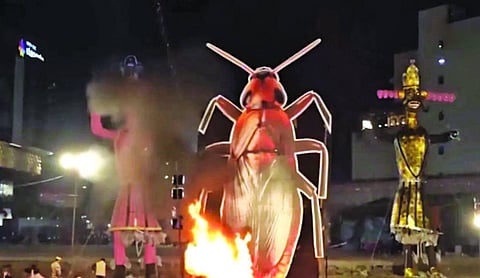
Brazen incidents occur in India-a nation celebrated for its diversity-that leave the public deeply puzzled. On this Dussehra, a 30-foot effigy of a cockroach was burnt alongside the traditional figures of Ravana, Kumbhakarna, and Meghnad in the Pitampura area of Northwest Delhi. The event was organised under the aegis of the Shree Keshav Ram Leela Committee, whose leadership includes BJP MLA Ashok Goel and BJP leader Kapil Mishra. The latter officially set fire to all four effigies, including the cockroach.
The BJP leadership did not react to this unusual theological-cum-cultural event, presumably out of fear of a public backlash. Critics, however, view it as the weaponisation of Hindu rituals, warning that it runs the risk of triggering political reciprocity. In any case, even if inadvertent, the stunt trivialised a sacred occasion. The organisers used a revered festival to execute highly targeted political theatre, creating a dangerous and short-sighted precedent.
While the organisers officially claimed that the cockroach symbolised filth, disease, and unhygienic conditions to promote cleanliness under the Swachh Bharat Abhiyan, the move drew controversy. The event came amidst ongoing protests of Cockroach Janata Party (CJP) a pressure group which forced removal of Union Education Minister Dharmendra Pradhan. Despite attempts by the organisers to deny any political motive, the unusual departure from tradition generated signific social media buzz and political friction.
The CJP has a tendency to capitalise on words and observations, much like how it acquired its unique name on the comment of CJI Justice Surya Kant, during a Supreme Court hearing, comparing the unemployed youth to "cockroaches and parasites." The very next day, former AAP political communications strategist Abhijeet Dipke launched the online movement. The name was quickly reclaimed online as a symbol of resilience, survival, and humorous protest against systemic unemployment and political neglect. The group has recently made headlines for defying prohibitory orders at Jantar Mantar, and their subsequent detentions and court cases.
The burning of the cockroach effigy alongside the traditional figures of cosmic evil raises several critical ethical issues cantered around religious sanctity, environmental safety, and socio-political satire.
Ethical Sanctity of Religious Tradition
Altering Sacred Texts: Dussehra is a sacred function tied to the Ramayana. burning of effigies is traditionally reserved exclusively for Ravana, Kumbhakarna, and Meghnad, who represent specific cosmic evils defeated by Bhagwan Rama. Introducing a household pest-widely perceived as a caricature of a Gen Z pressure group-into this ritual is viewed as an ethical violation. It trivialises a profound, time-honoured spiritual custom for the sake of political contempt.
Intentionality of the Ritual: The ritual of Ravana Dahan represents the triumph of spiritual righteousness over moral decay. Ethically, integrating concepts like public sanitation or political mockery dilutes the purely moral and spiritual lessons the festival is intended to pass down to future generations.
Public Hygiene Awareness.
"Cleanliness" Defence: The event organisers justified the move saying that it is a symbol of disease and filth, attempting to tie the act to a civic "good over evil" message.
Dehumanisation Risk: An ethical issue arises with the timing of the event. Because the CJP is actively demonstrating in the capital, critics argue that reducing a group of human protestors to "pests" to be ritually burned is ethically dangerous. In social ethics, comparing human ideological opponents to insects carries historically dark connotations of dehumanisation, designed to lower the threshold for hatred against a group.
Environmental and Safety Ethics
Air Pollution in Delhi: Dussehra takes place in October, a month when Delhi's Air Quality Index (AQI) routinely plummets into the "hazardous" category and adding an unnecessary fourth effigy further contributed to the city's toxic smog.
Historical Context of Modern Effigies
Historically, departures from burning only the traditional trio on Dussehra have occurred across the country, creating a loose modern precedent:
Effigies of Terrorism: Over the years, many Ramlila committees across North India have constructed a fourth effigy decorated with the faces or names of global terrorist outfits, such as ISIS or Jaish-e-Mohammed.
Corruption and Inflation: In several local community celebrations, a fourth figure labelled as Bhrashtachar or Mehangai is set ablaze to mirror the everyday financial hardships of the public.
Pandemic Years (COVID-19): During Dussehra in 2020 and 2021, multiple cities built and burned a distinct fourth effigy crafted to look like the coronavirus particle.
Crimes Against Women: Some organisers have occasionally built a fourth demonic figure to represent rapists, reflecting societal demands for women's safety and justice.
Traditionalists and religious scholars heavily critique all such instances for trivialising the theological meaning of the Ramayana for contemporary agendas.
Legal Weight: The organisers now run the risk of facing FIRs or lawsuits accusing the committee of deliberately hurting religious sentiments. Notably, AAP leader Saurabh Bharadwaj has filed a complaint, taking the issue from public debate to a legal issue of religious freedom.
Threat of Symmetrical Retaliation: If ruling parties begin using state-aligned Ramlila committees to burn effigies mocking political rivals, opposition-ruled states have been given a blueprint to reciprocate. When shared cultural anchors are turned into partisan weapons, it leaves no sacred or neutral ground left in public life.Political battles belong to the parliament, the courtrooms, and periodic elections-not on the ritual grounds of Ravana Dahan.
Those who celebrate compromising religious sanctity for a quick political jab today will have no ground to stand on when the same coin is flipped against them tomorrow.