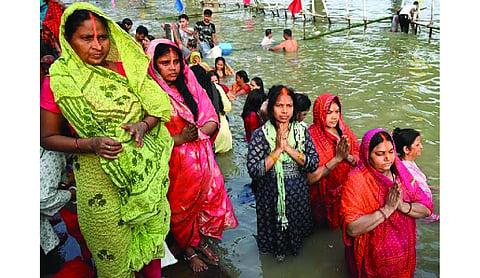

There is something profoundly moving about watching thousands of people gather beside a waterbody, their offerings held aloft, waiting for the sun to disappear beyond the horizon. As the evening light softens, hands rise in prayer, traditional songs fill the air, and the setting sun receives its offerings. The following morning, before the world has fully awakened, the same devotees return to welcome its first rays. Between these two moments lies the essence of Chhath, an extraordinary expression of gratitude to nature and the forces that sustain life.
I have been observing Chhath at Uttarayan in Dhanbad (Jharkhand) since 2019, though my connection with the festival goes back to childhood, watching my mother and aunts observe it year after year. Over time, it has become much more than a religious tradition for me. It is an opportunity to pause, reflect and reconnect with nature. Each year, standing in the Chhath pond, I am reminded of our deep dependence on the sun, water, soil and air, the very elements that sustain life.
Chhath, also known as Surya Shashthi, is observed on the sixth day of the Hindu month of Kartika, usually six days after Diwali. Its four-day observance begins with Nahay Khay, followed by Kharna, Sandhya Arghya and Usha Arghya. Yet, beyond its rituals and traditions, Chhath carries a philosophy that is remarkably universal. It celebrates nature not as something to be possessed or exploited, but as something to which humanity is indebted. One of the most distinctive aspects of Chhath is its worship of both the setting and the rising sun. While many traditions associate sunrise with hope and renewal, Chhath also accords equal reverence to sunset. This is a beautiful expression of gratitude.
We do not honour nature only for what it promises tomorrow, but also for everything it has given us today. The setting sun is not considered less worthy of worship because it is disappearing beyond the horizon. Its contribution does not diminish with the fading light. The rising sun, in turn, signifies renewal and continuity. Together, these offerings acknowledge the cycles of nature, where endings and beginnings are inseparable. Over the years, standing in the Chhath pond at Uttarayan, I have come to see the festival as a deeply personal expression of our relationship with nature. Its scientific significance is as compelling as its spiritual meaning. The sun sustains almost every ecosystem on Earth. Through photosynthesis, it provides the energy that supports food chains, while solar radiation drives the water cycle, atmospheric circulation and rainfall. It shapes agriculture, influences climate and makes life possible.
For me, the offerings during Chhath are an expression of gratitude for these natural processes and our dependence on them. What makes Chhath particularly meaningful is its simplicity. There is no need for an elaborate intermediary. A riverbank or pond becomes the place of worship, the open sky its canopy, the sun the object of reverence and the earth the source of offerings. There is something profoundly humbling about this simple yet intimate connection with nature. It reminds me that our faith, our survival and our relationship with the natural world are inseparable. The four days of observance demand considerable discipline. Nahay Khay begins with ritual cleansing and simple food. Kharna involves a day-long fast, broken in the evening with offerings of kheer and puri. This is followed by the rigorous nirjala vrat, observed by many devotees for approximately 36 hours without food or water. The observance culminates with Sandhya Arghya to the setting sun and Usha Arghya to the rising sun. The discipline is extraordinary, but so is the collective effort behind it. Families prepare together, traditional foods are made with care, neighbourhoods organise themselves, and people contribute in different ways. The festival brings together individual faith and community participation in a manner that is both intimate and inclusive.
The offerings of Chhath tell their own story of the relationship between humanity and nature. Sugarcane, bananas, coconuts, seasonal fruits, turmeric, ginger and thekua are carefully arranged in traditional bamboo baskets and winnowing fans. These are not simply ritual ingredients. They represent agricultural abundance, the labour of farmers, the generosity of the soil and the seasonal rhythms of rural life. There is something particularly beautiful about this circle of reciprocity. The devotee offers fruits and grains to the sun, although their growth depends on sunlight, water, soil and countless ecological processes. The bamboo baskets themselves reflect traditional skills and livelihoods rooted in nature. What is offered is, in essence, a part of what nature has already given us.
Chhath's folk songs, largely preserved in Bhojpuri, Maithili and other regional traditions, add another dimension to this cultural inheritance. Passed down through generations, particularly by women, these songs carry memories of family, motherhood, devotion, longing and the changing seasons. They are not merely accompaniments to the rituals but a living archive of collective memory. The festival has also travelled far beyond Bihar and Jharkhand. Wherever communities have settled, across India and overseas, they have carried Chhath with them. Water bodies in distant cities become spaces of familiar devotion, demonstrating how deeply cultural identity remains connected to nature and inherited traditions.
For me, the presence of water in Chhath is particularly significant. When devotees stand in a river or pond to offer arghya, they are engaging with an element indispensable to every form of life. Rivers sustain agriculture, replenish groundwater, support biodiversity and provide livelihoods. Ponds and wetlands regulate local hydrology and support ecological systems, often without receiving the attention they deserve. Yet, there is a contradiction we must confront. We worship the sun but frequently disregard the natural systems that sustain life. We regard rivers as sacred, yet allow them to become polluted. We celebrate the earth's bounty while overlooking soil degradation, groundwater depletion and the disappearance of wetlands. The reverence expressed during Chhath should inspire a responsibility that extends throughout the year. The cleanliness of rivers cannot matter only during the festival. Ponds and wetlands deserve protection beyond the days of worship. Groundwater must be replenished and used responsibly, and the ecological systems that sustain communities must be respected. This is not about changing traditions or questioning faith. It is about recognising the responsibility that accompanies reverence. Gratitude cannot remain confined to prayers and offerings.
It must find expression in how we live and treat the natural world. In an age of climate uncertainty, ecological degradation and growing pressure on water resources, Chhath offers a particularly relevant reminder. Human beings may build cities, develop technologies and reshape landscapes, but our survival remains inseparable from the natural processes that have sustained life for millennia.
Since beginning my observance of Chhath at Uttarayan in 2019, I have increasingly come to value the reflection that the festival encourages. Each year, the setting sun and the first light of dawn remind me that we are part of something much larger than ourselves. As the morning light spreads across the water, the fast concludes, prasad is shared, and devotees gradually return to their everyday lives. Yet, the most meaningful offering should perhaps be the thought we carry back with us.
We owe the rivers our care, the soil our respect, the forests their space and the water bodies their ecological integrity. Above all, we owe the natural world an understanding that our existence is sustained by a generosity we can never fully repay.
Perhaps that is the true beauty of Chhath. It does not place humanity above nature; it reminds us that we belong to it. When we bow to the setting sun and welcome the rising sun, we are acknowledging our dependence on nature, celebrating the continuity of life and expressing gratitude for everything the earth gives us. Chhath is ultimately more than a festival of faith. It is an enduring reminder that gratitude for nature must also become a commitment to protect it.
The writer is Managing Trustee, Megh Pyne Abhiyan; Views presented are personal.