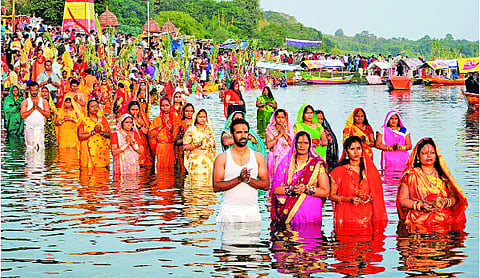

Beyond offering prayers to the Sun, Chhath embodies gratitude to nature, equality, community, and the enduring human need to remain connected to one's roots
Some festivals are marked on calendars. Some live in memories. And a rare few become part of a community's collective consciousness. Chhath belongs to the last category. It is not merely a religious observance; it is a profound civilisational expression of gratitude, discipline, equality, environmental consciousness and belonging. Originating in the cultural landscape of Bihar, Jharkhand, eastern Uttar Pradesh and the Terai region of Nepal, Chhath has travelled far beyond its traditional geography. It is now observed in cities across India and in many parts of the world. Yet, despite this remarkable expansion, its emotional centre remains unchanged: the river, the pond, the family, the village and the soil from which its traditions emerged.
Years ago, during an academic visit to France, I was asked by a group of French participants to speak about something distinctive and fascinating about Bihar. I chose Chhath. Their curiosity encouraged me to study the festival more deeply, not merely as a religious ritual but as a cultural phenomenon with social, philosophical and ecological dimensions. I subsequently wrote an article in French, Chhath Puja: l'adoration du Dieu Soleil, which was later published by the Indian Council for Cultural Relations in its French-language publication. That experience reinforced my belief that while Chhath may have emerged from a particular region, its underlying message is universal. At its heart, Chhath is an expression of gratitude.
The Sun gives us light and energy. Water sustains life. The earth gives us food.
Agriculture, seasons and the rhythms of human existence are deeply intertwined with the natural world. Yet modern civilisation has increasingly come to view nature merely as a resource to be consumed. Chhath offers a different perspective. Nature is not simply something from which we take; it is something before which we bow. The offering of arghya to the Sun is therefore more than a ritual. It is an acknowledgement of our dependence on the natural order that sustains life.
This philosophy is reflected even in the materials used during the festival. Seasonal fruits, sugarcane, bamboo baskets, soops and dauras bring farmers, artisans, small traders and households into one shared cultural economy. Chhath reminds us that the people who grow our food and make the objects used in our rituals are not peripheral to society; they are essential to it. Its second great message is equality.
At the Chhath ghat, social distinctions tend to lose their significance. There is no privileged worshipper and no second-class devotee. Rich or poor, powerful or ordinary, woman or man-everyone stands before the same Sun. At the moment of arghya, identity is reduced to that of a devotee. This is why Chhath cannot be adequately described as merely a religious festival. It is also a powerful social institution-one that creates a temporary but deeply meaningful space of equality.
Perhaps the most profound symbolism of Chhath lies in the fact that devotees offer arghya not only to the rising Sun but also to the setting Sun. Modern society has become accustomed to celebrating success, power and achievement. We instinctively honour what is rising and overlook what is declining. Chhath challenges that instinct. It teaches us to respect the setting Sun as much as the rising one. There is a quiet philosophy here: life is not defined only by ascent. Decline, transition and endings are also part of existence. A society that can honour the setting Sun may be better equipped to accept change, ageing, failure and impermanence with grace.
The festival's four-day cycle-from Nahay-Khay and Kharna to the evening and morning offerings-is equally a celebration of discipline and self-restraint. The rigorous practices associated with the observance demand physical endurance, mental resolve, cleanliness and extraordinary attention to ritual purity. The fast becomes not merely an act of devotion but a form of personal discipline. Yet the most moving story of Chhath may not be written at the ghat at all. It is written in the journey people undertake to reach it.
For millions who live away from their native places, Chhath is a powerful summons to return home. A migrant worker in Delhi, Mumbai or Surat, a software professional in Bengaluru or Hyderabad, or an Indian living thousands of kilometres away-all may feel the same pull when Chhath approaches. For some, it is the anticipation of eating prasad prepared by their mother. For others, it is the hope of seeing parents after months of separation. For an entire generation raised in metropolitan apartments, it is an opportunity to rediscover a village, a pond, a riverbank and a childhood landscape that may otherwise survive only in memory. In this sense, Chhath has become a vast cultural reunion.
The geographical spread of the festival-from major Indian cities to countries with sizeable Indian communities-reflects the strength of this cultural memory. The migrant may change cities, professions and even continents, but the songs, rituals and emotional vocabulary of Chhath continue to connect him or her to home. However, the modern expansion of Chhath also places a new responsibility before us: if we worship nature, are we prepared to protect it?
It is difficult to reconcile reverence for rivers with plastic waste in the same waters. If the ghat is sacred, keeping it clean must become an integral part of the observance. Environment-friendly offerings, reduced use of plastic, proper waste segregation, artificial ponds where necessary, and post-festival cleaning should not be treated merely as administrative measures. They should be understood as expressions of the very faith that brings people to the riverbank. The same principle applies to public safety.
Chhath brings enormous crowds to water bodies. Safe ghats, adequate lighting, barricading, medical assistance, crowd management, traffic regulation, special attention to children and women, and clearly planned emergency evacuation routes are therefore essential. Devotion and discipline must go together. A safe celebration is not a restriction on faith; it is a protection of faith. The deeper relevance of Chhath becomes even clearer in an age of shrinking families, expanding cities and increasing alienation from nature. Thousands of people standing together beside a river is not merely a religious spectacle. It is an affirmation of community.
People meet, exchange greetings, renew old relationships and reconnect with neighbours. Families separated by distance come together. The festival creates social bonds without requiring a formal institution or elaborate infrastructure. Perhaps this is Chhath's greatest strength. It reminds us that modernity does not require us to abandon our roots.
A tree may spread its branches across a vast landscape, but its strength continues to come from its roots. Human beings are no different. Our professional achievements and modern identities may take us far from our birthplace, but our earliest memories, values and cultural experiences continue to shape who we are. Chhath, therefore, is not simply worship of the Sun. It is a celebration of gratitude towards nature, respect for labour, commitment to family, responsibility towards society and love for one's roots.
The challenge before us is to do more than merely celebrate it. We must live its values. We must keep our ghats clean, protect our rivers, respect farmers and artisans, avoid unnecessary extravagance, care for the vulnerable and carry the principle of equality beyond the ghat into everyday life. When we offer arghya to the setting Sun, perhaps we should ask ourselves what we have done for the nature to which we owe our existence.
And when we offer arghya to the rising Sun, perhaps we should make another pledge: that the next generation will inherit not merely the story of Chhath, but a living tradition-celebrated beside clean rivers, under an open sky, with the same spirit of community and gratitude. That, ultimately, is Chhath.
Not merely a festival, but a way of seeing life. Not merely one ghat, but many meanings. And a cultural stream flowing from the soil of Bihar that, wherever it travels, quietly leads human beings back to their roots.
A tree may spread its branches across a vast landscape, but its strength continues to come from its roots. Human beings are no different. Our professional achievements and modern identities may take us far from our birthplace, but our earliest memories, values and cultural experiences continue to shape who we are. Chhath, therefore, is not simply worship of the Sun. It is a celebration of gratitude towards nature, respect for labour, commitment to family, responsibility towards society and love for one's roots.
Dr Kumar Ashish, IPS is DIG, Koshi Range, Saharsa, Bihar. He is known for pioneering people-centric policing initiatives such as AAWAZ DO, Nasha-Mukt Koshi Abhiyan, E-Bharosa; Views presented are personal.