
Author: Nalini Ranjan
An extraordinary celebration of devotion, discipline, nature and community, Chhath is not merely a religious festival for Purvanchalis but an inseparable part of their cultural identity and emotional connection with their roots.
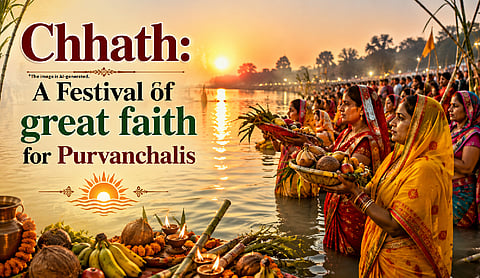
As the sun descends towards the horizon, riverbanks, ponds and other water bodies come alive with an extraordinary spectacle of faith. Thousands of devotees, dressed in traditional attire, stand in waist-deep water with bamboo baskets filled with fruits, sugarcane, coconuts and homemade offerings. Devotional songs fill the air, earthen lamps illuminate the surroundings, and folded hands rise in prayer towards the setting sun. This is Chhath, one of India's most distinctive festivals, celebrated with immense devotion, particularly by people of the Purvanchal region.
For the people of Bihar, eastern Uttar Pradesh, Jharkhand and neighbouring regions, Chhath is much more than a festival. It is an emotion, a tradition and a powerful expression of cultural identity. Wherever Purvanchalis have travelled in search of education, employment and better opportunities, they have carried this tradition with them. From the banks of the Ganga in Patna and Varanasi to the Yamuna in Delhi, Mumbai and distant countries, Chhath continues to unite people through a shared bond of faith.
Dedicated primarily to Surya Dev, the Sun God, and Chhathi Maiya, the festival expresses gratitude to the ultimate source of energy, light and life. The Sun sustains humanity, agriculture, nature and the entire living world. Through Chhath, devotees acknowledge this life-giving force and seek blessings for the health, happiness and prosperity of their families.
One of Chhath's most remarkable features is the worship of both the setting and rising sun. While many traditions associate worship with sunrise, Chhath gives equal importance to sunset. This carries a profound philosophical message: we must respect not only beginnings and achievements but also endings and transitions. Just as the sun sets only to rise again, difficulties are followed by hope and renewal. The festival teaches gratitude, humility, patience and faith.
Observed twice a year, Kartik Chhath (October-November) and Chaiti Chhath (March-April), the festival follows a four-day sequence of rituals. Kartik Chhath, celebrated six days after Diwali, is particularly popular.
The first day, Nahay-Khay, marks purification and preparation. Devotees take a holy bath, clean their homes and prepare a simple vegetarian meal, traditionally consisting of rice, gram dal and pumpkin. The second day, Kharna, involves fasting throughout the day, followed by an evening meal of jaggery-based kheer and roti. After Kharna, the main devotee, or vratin, undertakes a rigorous fast traditionally lasting approximately 36 hours without food or water.
The third day is marked by Sandhya Arghya, the evening offering to the setting sun. Families prepare traditional prasad and arrange fruits, sugarcane, coconuts and thekua in bamboo baskets and winnowing trays known as soop. As evening approaches, devotees gather at riverbanks and ghats, sing folk songs, light earthen lamps and offer prayers while standing in water.
The final day begins before sunrise with Usha Arghya, or Bhor ka Arghya. As the first rays illuminate the horizon, devotees offer prayers to the rising sun. They subsequently break their fast and distribute prasad among relatives, neighbours and friends, bringing the four-day observance to a close.
No discussion of Chhath is complete without mentioning its distinctive culinary and musical traditions. Thekua, prepared from wheat flour, jaggery and ghee, is perhaps the festival's most recognisable offering. Bananas, coconuts, sugarcane, seasonal fruits and rice laddoos also form part of the prasad. Preparing these offerings is a family activity, undertaken with great care and traditional standards of cleanliness.
Equally significant are Chhath songs in Bhojpuri, Maithili, Magahi and other regional languages. Passed down through generations, they preserve the memories and emotions associated with the festival. The soulful songs of legendary folk singer Sharda Sinha have become synonymous with Chhath, capturing the devotion and cultural sentiments of millions. For many Purvanchalis, these melodies evoke childhood memories, ancestral homes, village ponds and family gatherings.
Chhath also reflects the values of inclusiveness and social harmony. People from different castes, economic backgrounds and communities gather at the same ghats to participate in the celebrations. Traditionally, the rituals do not require the mediation of a priest; devotees offer prayers directly through personal faith and discipline. Women have historically played a leading role in preserving the tradition, while men, children and other family members contribute to preparations. It is therefore both an individual spiritual commitment and a collective family undertaking.
Its emotional significance is particularly evident among Purvanchalis living away from their native places. In Delhi, Mumbai, Kolkata, Surat, Bengaluru and even countries such as Mauritius, Nepal, the United Kingdom and the United States, communities organise celebrations near rivers, lakes and specially prepared ghats. For migrant workers, professionals and students, Chhath offers a powerful sense of belonging. Many also undertake long journeys to celebrate with their families in their ancestral villages. For them, this is not merely travel but an emotional homecoming.
Chhath carries an important environmental message as well. Its reverence for the Sun and natural water bodies reflects humanity's dependence on nature. However, the growing scale of celebrations makes environmental responsibility essential. Keeping rivers and ponds clean, avoiding plastic and ensuring proper sanitation and waste management are necessary to preserve the ecological values that the festival represents. A festival dedicated to nature must also inspire us to protect it.
In an age of rapid urbanisation, migration and changing lifestyles, Chhath remains a remarkable symbol of cultural continuity. It connects generations, strengthens family relationships and brings communities together. Above all, it reminds us that genuine devotion depends not on wealth or elaborate arrangements but on sincerity, discipline and gratitude.
As the setting sun disappears beyond the horizon and the rising sun illuminates the morning sky, millions of devotees offer prayers for health, happiness, prosperity and family well-being.
That is the true spirit of Chhath: where faith meets nature, tradition meets modernity, and millions of hearts beat together in devotion. For every Purvanchali, wherever they may live, Chhath is not simply an annual religious occasion. It is an enduring emotion that brings them closer to their roots and reminds them of who they are. It is, indeed, a festival of great faith.
Dr. Nalini Ranjan is a public policy expert; Views presented are personal.