
Author: Atrayee Sinha
Bangladesh has until November 24 2029, to fix its banks and its economy. The clock has already started ticking. On 29 October 2026, the UN General Assembly decided to grant Bangladesh a three-year extension before its official LDC graduation. The extended deadline buys time for Bangladesh, but it has to fix its core economic issues, especially the banking system. Of the country’s 61 banks, 22 carry accumulated losses. About one in every three taka lent is in default. Three years sounds long. It is not, for a banking system in this state.
Economic data from the Bangladesh Bureau of Statistics (BBS) show that Bangladesh’s economy crossed $501 billion in FY26, up from $456 billion. However, the FY26 growth, first projected at 4.14% in its July report, has now been revised to 3.68%. The International Monetary Fund (IMF) expects 3.2% growth for FY27, probably the lowest in nearly four decades. The World Bank projects 3.4% for the same year, and the Asian Development Bank (ADB) puts it at 4%. The government target sits at 6.5%. The gap between that target and every forecast is wide.
The Banking sector has been hit hard. As of March, the combined accumulated losses of these 22 banks out of 61 banks stood at Tk 2.54 trillion. This was mentioned in a report submitted by Bangladesh Bank to the Parliamentary Standing Committee on the Ministry of Finance. Bangladesh Bank informed the parliamentary committee that as of 30 June 2026, the amount of defaulted loans stood at Tk 6.07 trillion, or about 33% of total loans. The most likely reasons are fake and anonymous loans given under political pressure, a business downturn, or the energy crisis. UNB has traced this crisis to a long decade of politically influenced lending as well as weak supervision.
National Professor Mahbub Ullah remarked that most banks are now on the brink of collapse. He said, "Bangladesh has turned into an exploitative state. Who does this system of exploitation serve? Not the general public, but a small group of wealthy and influential businesspeople and billionaires whom we call oligarchs. The state itself has created these oligarchs."
Banks have also stalled their lending. Private credit grew by only 4.47% in the year to June 2026. That is the lowest on record and below the central bank’s 5.5% target for the month. Banks, weighed down by bad loans, lend less. Even a Tk 600 billion stimulus has not yet revived lending.
The newspaper Daily Ittefaq reported in August 2026 that Bangladesh Bank has launched an 18-month plan to cut bad loans. The bank has also adopted a new provisioning model, due to be fully in place by December 2027. It should be understood that both of these fixes are slow and would take time to show any real effect. The losses came from political choices in lending, so the fix has to start there. Naming the top 20 defaulters in parliament was a start. Bangladesh must now publish who received the rest of the bad loans, and how much has been recovered. That is the toughest part, but it is also the part that matters. Without that, the new provisioning model only records the damage without a solution.
The major political parties are playing the blame game. Each camp blames another, and the accounts contradict each other. The Bangladesh Nationalist Party (BNP), in opposition, criticised the interim government’s VAT and duty rises on over 100 products. The Awami League said the interim government left the economy paralysed. Muhammad Yunus said corruption under the Awami League took the economy below zero. A Prothom Alo review at six months said the elected government inherited high inflation, weak investment, a weak banking sector and a revenue shortfall.
However, the economic data supports no such single account of failure for the whole economy. Inflation had already accelerated from 2023 and kept staying elevated. It squeezed the economy long before the interim government was even formed. The IMF has predicted inflation of 10.9% for FY27. Growth was at 4.22% in FY24 and 3.49% in FY25. Private credit hit its record low four months after the elected government took office, and banking stress built up over a decade of politically influenced lending.
The UN General Assembly moved Bangladesh’s and Nepal’s LDC graduation from November 2026 to 24 November 2029. However, as reported by the media, a European Union delegate said political transitions alone do not justify extensions, though Bangladesh’s might merit an exception owing to its tumultuous political unrest. It’s important to understand that a three-year delay is not a solution for Bangladesh.
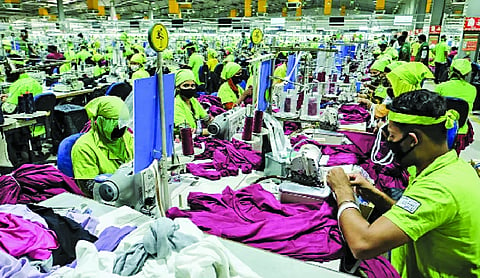
Duty-free access runs to November 2029. After that, Bangladesh needs GSP+ or a trade deal, with stricter rules and possible safeguards on apparel. The EU-India and EU-Vietnam agreements, which have recently concluded, add to the competition Bangladesh faces in the global market.
How much stake does India have, and how should India react? There is no doubt that Bangladesh’s economic slowdown presents India with a potential opportunity to strengthen its position in global manufacturing and apparel markets, particularly as buyers look to diversify sourcing destinations.
However, Bangladesh’s difficulties are not an automatic advantage for India, given the competition from established exporters such as Vietnam. India is also already tied to this slowdown through trade. Bangladesh imported $10.96 billion of goods from India in FY26. Its exports to India were only $1.75 billion. A weak garment sector is therefore a risk for Indian yarn and fabric suppliers too. For New Delhi, the gain will come only if it uses the EU-India FTA, once in force, to build its own manufacturing capacity and win buyers who are looking beyond Bangladesh.
Dhaka’s weakness becomes Delhi’s strength only if Delhi offers better stability- economic and political. The three extra years are not a respite; it’s a deadline. Without economic independence and economic stability, the three extra years in the LDC group are just a time-delaying technique. It will be worthwhile only if the country uses them to clean up its banks and to answer queries related to lending that ultimately broke its banking system. Otherwise, Bangladesh will face the same problems in 2029, with few or no solutions at hand.
The writer is an Associate Research Fellow at the Centre for Policy Studies, New Delhi; Views presented are personal.