
Author: Brij Nath Pandit Watloo Betab
A poem, when it works, is an action of the mind captured on a page--Anne Carson
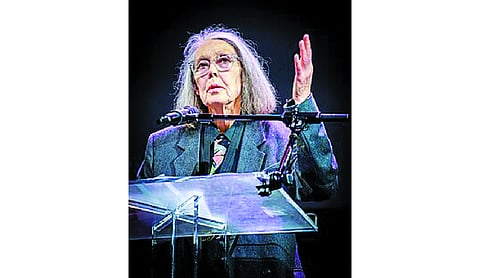
She defied notions and styles and wrote that love is devastation, or deconstruction, Literary. Her name is Anne Carson. Poet, essayist, translator, classicist, she has worked in all genres, prose, poetry, autobiography and explored everything concerning the human: psychology, emotions, relations, desires and urges.
Anne Carson, born in Canada in 1950 and a citizen of Iceland since 2022, is the 2026 Nobel Prize winner for Literature. She is credited with creating new forms for contemporary literature by blending classical antiquity with modern thought. She learned ancient Greek in high school during lunch hours from a generous teacher, earned her PhD from the University of Toronto, studying 'Desire and Philosophy', and taught classics and comparative literature at major American universities.
Carson has over two dozen books, including translations of Sappho and Euripides. Married to visual artist Robert Currie, whom she calls her "collaborator-husband person" and credits him credits him for shaping the visual life of her books.
In her poetry, Carson does not make a spectacle of personal suffering. She is hesitant, almost silent about it, yet the poet within her cannot suppress emotion. That restraint is what makes her devastating.
Consider this early miniature, Small, sad ecstasy of love:
I like being with you all night with closed eyes
What luck here you are coming
along the stars
I did a road trip
All over my mind and heart
And There you were
Kneeling by the roadside
With your little tool kit
Fixing something.
Love here is not looking but feeling in the dark with closed eyes. It is not filmy happiness. It is quiet and hurts a little. The lover travels all over his own mind and heart like a long road trip, and in the middle of nowhere finds the beloved kneeling, fixing something. Desire becomes an interior search.
The same exile deepens in "Town of Finding Out About the Love of God".
Before this day.
Now my suitcase is ready.
Two hardboiled eggs.
For the journey are stored.
In the places where.
My eyes were.
How could it be otherwise?
Like a current.
Carrying a twig.
The sobbing made me.
Audible to you.
When she leaves, she claims no property. Only two boiled eggs stored where her eyes were. She has cried so much she is hollowed, so empty that eggs can fit in her eye sockets. She has no river-flow left; she is reduced to a twig carried by a current. Then the final punch: "The sobbing made me audible to you." Before, she was invisible, unheard. Only when she breaks down does she become real to the other. It is pain that makes us heard.
Her most philosophical statement about the body comes in "God's List of Liquids" (1992):
It was a November night of wind.
Leaves tore past the window.
God had the book of life open at PLEASURE
and was holding the pages down in one hand because of the wind from the door.
For I made their flesh as a sieve
Wrote God at the top of the page
And then listed in order.
Alcohol - Blood - Gratitude - Memory - Semen Song -Tears - Time.
God made flesh as a sieve. Whatever is bodily pleasure is temporary; it oozes out. The background is the Book of Life, the heavenly record of those who inherit eternal salvation. At the page marked PLEASURE, God writes only what leaks.
This is not out of sync with Indian thought. We believe the body is a temple where the Lord resides, yet insist on keeping it clean and pure. Brahmacharya - conduct consistent with Brahman - means mastery over senses. Lal Ded, the 13th-century Shaivite mystic of Kashmir, says:
Kyah karhe panctsatan dahan te kahan, Vakhshun yeth leji yim karith gay.
How do I handle the five elements, ten senses and the mind? Without harmony, they simply drain the pot, the body, of its divine purpose.
My reading is that Carson says humans mistake momentary leakages for true pleasure. Recently, Premananda Maharaj of Vrindavana said in mundane terms that humans find pleasure in sex, and that sex organs are where the body's dirt exits. He spoke spiritually, not philosophically. Carson gives the same thought modern artistic realism, by placing alcohol and memory alongside semen and tears, without moralizing.
This brings me to Carson's own line: a poem is an action of the mind captured on a page. A poem is a process. Kashmir Shaivism elaborates this as Vac or Shabda, the creative energy of Shiva. Vac has four stages: Para, transcendent divine awareness; Pashyanti, where intention begins to take shape; Madhyama, where thought forms in the brain; and Vaikhari, the gross audible level we hear and share. Carson's list is exactly that journey, an experience moving from individualism to universality, a full circle from Blood (birth) to Time (death). As pleasures are not solid, God must hold the pages down against the wind. That she lists them alphabetically suggests one follows the other in a vicious circle. Her poetry reminds me of traditional Kashmiri romantic poetry. Until the early twentieth century, almost all male Kashmiri poets wrote as if they were female. I had thought this was due to Radha Rani and Mira Bai, the great voices of 15th-century Bhakti, loving devotion to God, which began in the South in the 7th century and peaked in the North. Now I see another reading: every lover, to be loved, must impersonate the feminine. Drink all the sex there is, exhaust every seduction, still you die.
That is Carson's final equation, and why she matters to us in Kashmir. She begins in Greek, passes through a sieve of liquids, and ends where Laleshwari, Lal Ded and Bhakti ended: the pot leaks, the eggs replace the eyes, the twig is carried by the current. And yet, put garlands on, have a drink, remember Aphrodite. Between Blood and Time, Life and death, that small, sad ecstasy is all we have.
The writer is a broadcaster, writer and literary scholar who has served All India Radio and Doordarshan. He has served on the Kashmiri Advisory Boards of Bharatiya Jnanpith, the National Book Trust and the Sahitya Akademi; Views presented are personal.