
- HOME
- INDIA
- WORLD
- BUSINESS
- STATES
- LAW & JUSTICE
- ENTERTAINMENT
- SPORTS
- VIEWPOINT
- LIFESTYLE
- TECH
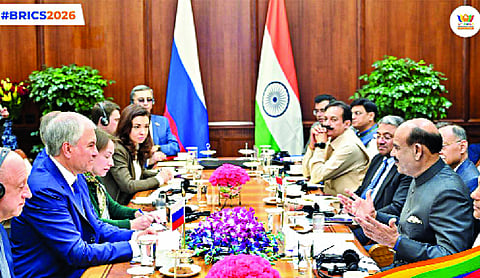
At a time when geopolitics is in a churn, Lok Sabha Speaker Om Birla is hosting the two-day 12th BRICS Parliamentary Forum meeting on the 26th and 27th of this month, close on the heels of the BRICS summit held in Delhi on the 12th and 13th of last month. Prime Minister Narendra Modi, who has earned a formidable reputation as a world statesman, will also grace the event and interact with the high dignitaries. This thoughtful gesture on his part resonates well at a time when the world is faced with various challenges. His presence amidst the distinguished lawmakers from the BRICS parliamentary fraternity will enable them to have direct interface with him.
In recent years, the Speaker of the Lok Sabha, Om Birla, and the Deputy Chairman of the Rajya Sabha, Harivansh, have been playing a very important role in parliamentary diplomacy, far from the media gaze. The Speaker of the Lok Sabha organised the Commonwealth Speakers’ and Presiding Officers’ Conference in January this year and, earlier, the G20 Speakers’ Conference in October 2023. Both also participated in the BRICS Parliamentary Forum in Brasília in June last year. The role played by the all-party parliamentary delegations deputed to various parliaments of the world after ‘Operation Sindoor’ is also an example of parliamentary diplomacy.
Unfortunately, there is not much awareness about the efficacy and usefulness of parliamentary diplomacy. It is not widely known that, before the United Nations was born, the Inter-Parliamentary Union (IPU) was established in 1889. Parliamentary diplomacy has its own salience. It may be mentioned that, after the Falklands War between the United Kingdom and Argentina in 1982, when there were no diplomatic relations between the two countries, the ice was broken at the centenary celebration of the IPU in London in 1989, when both sides met. The margins of the summitry can always be thoughtfully availed of to broker an imbroglio or impasse. Through the bilateral meetings on the margins of the Forum, the Honourable Speaker will exchange views with his peers, and such interactions carry a great deal of strategic and diplomatic traction.
The BRICS Parliamentary Forum carries forward the mandate of the summit resolutions and declaration in the parliamentary domain and works in alignment with the principles and objectives of BRICS. In a way, the Forum supplements and complements the BRICS spirit of fraternity and fellowship. The contemporary world is faced with humongous challenges, and representative institutions at various levels are under stress to cope with the rising expectations of the people. Recognising the centrality of the people in governance, the central theme of the meeting is ‘Fostering Parliament for People-Centric Development’. The Forum will also deliberate on themes such as ‘Resilience: Strengthening Institutional Resilience for a Better Future’, ‘Innovations: Promoting Human-Centric Innovation in Artificial Intelligence’ and ‘Cooperation: Leveraging Parliamentary Cooperation for More Representative Global Governance’ in its plenary sessions.
At a time when the world is getting polarised and fragmented and a new world order is yet to be weaved, these issues are going to dominate the world discourse. With India emerging on the threshold of becoming the world’s third-largest economy and being the fastest-growing major economy in the world, it is only anachronistic that India does not find its rightful place in the comity of nations. It is against this backdrop that BRICS is emerging as the voice of the Global South, a new lexicon in international relations. The BRICS platform and the Parliamentary Forum provide occasions and opportunities for India to showcase its commitment and endeavours to redefine the world order. The Westphalian world order is decadent. The Non-Aligned Movement (NAM) has also lost its sheen and élan. Moreover, it was more of a talking shop. The expanded BRICS, on the other hand, has formulated concrete ideas and institutions in response to the changing realities of the time.
The brainstorming deliberations of the Forum, including those in the plenaries, will not only sharpen the issues that have already been discussed on earlier BRICS platforms, but the interactions among peers will also forge stronger bonds among them. It is a good opportunity for the Parliamentary Friendship Groups to avail themselves of the occasion to reach out to their peers.
The writer is the Consulting Editor of Journal Parliamentary Information (JPI) and a former senior fellow of the Monohar Parrikar Institute for Defence Studies and Analyses; Views presented are personal.